

Beauty ecommerce has a conversion problem that most teams misdiagnose. Traffic is healthy, and the product assortment is strong, but online shoppers search, browse, and abandon because the discovery experience fails them before they ever reach checkout.
The root cause is rarely a single broken feature. It's a fragmented product discovery system: site search that handles obvious queries but stumbles on shade names and ingredient searches, product data that's inconsistently tagged, recommendations that recycle the same top sellers regardless of context, and a merchandising team spending hours on manual fixes instead of strategic optimization.
Adopting a unified product discovery system is the way to fix it. One powered by a reasoning engine where search, browse, and recommendations share behavioral signals, product data powers every touchpoint, and improvements compound.
This guide breaks down the five pillars of a high-performing beauty product discovery system and closes with a 90-day roadmap to sequence your improvements and tie every change to a measurable outcome.
Selling More Health and Beauty Products Starts with a Unified Product Discovery System
The goal here isn't to swap out a point solution. It's to build the connected infrastructure that helps old and new customers alike find the right product at the right time across every entry point: the search bar, category pages, product detail pages (PDPs), recommendation carousels, and even offsite.
Leveraging a connected system of intelligent discovery channels matters because the system reasons and improves each digital entry point over time. AI-augmented product attributes (based on real shopper data) improve search ranking, faceted filters, and recommendation relevance. Behavioral signals from search teach the recommendations engine what shoppers actually buy. Category page optimization informs what autocomplete should surface.
When these capabilities share data and learning, a fix in one area lifts performance across all of them. Teams no longer work in silos.
What to optimize for
Before investing in any pillar, choose one primary KPI to optimize toward: conversion rate, revenue per session, average order value, lifetime value, or gross margin.
The mistake is choosing every possible way to optimize simultaneously, which, in practice, often means optimizing for nothing. Pick the metric that matters most to your business right now, and test everything against it.
The case of relevance vs. attractiveness
In the health and beauty market, "technically relevant" results aren't enough.
When a shopper searches for "moisturizer for sensitive skin with SPF," dozens of products match due to keyword overlap. The discovery system's job is to go beyond relevance and return attractive items, or the products most likely to satisfy this specific shopper, based on what shoppers with similar behavior have purchased.
A system that learns from verified shopper behavior — clicks, add-to-cart events, purchases, reformulations — can prioritize items that actually convert. Not just items that share surface-level attributes with the query.
For health and beauty, where dozens of technically correct options exist for almost every search, attractiveness-based ranking is the difference between a confident purchase and an abandoned session.
Pillar 1: Master Ecommerce Site Search by Reducing Errors & Increasing Confidence
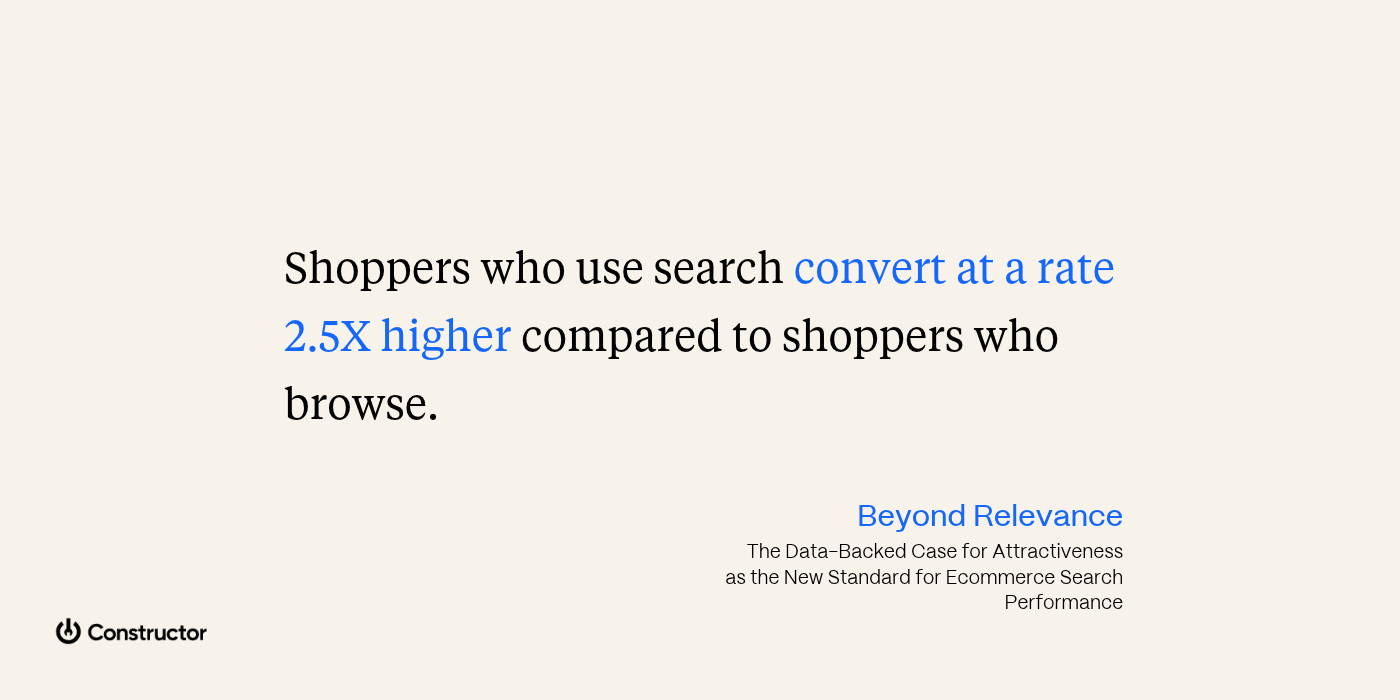
Site search is the highest-intent touchpoint for an ecommerce store. Shoppers who type a query into your search bar are explicitly signaling what they want — and data from Constructor shows that shoppers who use search convert at a rate 2.5X higher compared to shoppers who browse. How well your system interprets search queries and shopper intent determines whether they convert or leave.
The failure modes are well documented. User experience research from the Baymard Institute found that 56% of sites fail to fully support users’ search needs across eight key search query types. In beauty, these could be symptom-based queries ("good for dry skin"), ingredient queries ("niacinamide serum"), and shade-specific searches ("NC25 foundation"), together making up much of what your shoppers search for.
Zero-results pages compound the problem. Baymard's updated 2025 analysis found that 50% of sites struggle to provide useful recovery paths when a query returns nothing, leaving shoppers to guess at a new search or abandon entirely. Every zero-results page can be fixed to avoid losing potential sales.
Better product discovery may also create opportunities to protect margins without relying on discounts. Constructor's 2025 State of Ecommerce research found that 55% of shoppers would pay a premium for the right product if it meant avoiding the frustration of scrolling through irrelevant results. For beauty retailers, helping shoppers quickly find products that match their preferences can be just as important as competing on price.
How to optimize search for more beauty sales
Make sure your search engine supports these query types:
- (Skincare) brand + product queries ("Tatcha dewy moisturizer")
- Ingredient queries ("retinol eye cream," "vitamin C serum")
- Shade and finish queries ("warm-toned foundation," "matte lip color")
- Skin type and concern queries ("acne-prone toner," "sensitive skin sunscreen")
- Symptom and outcome queries ("reduces pores," "brightens dark spots")
- Thematic and routine queries ("summer skincare routine," "travel-size kit")
And when a search returns no results, give shoppers a way to recover:
- Implement redirect rules to curated landing pages for high-volume no-result queries
- Build synonym maps for health and beauty website-specific vocabulary: "BB cream" and "tinted moisturizer," "contour" and "bronzer," shade family aliases
- Enable typo tolerance and phonetic matching ("niasinamide" → "niacinamide")
- For persistent no-results, surface category fallbacks or relevant editorial content ("See all moisturizers" or "Guide to finding your foundation shade")
What to measure
Track these metrics to see whether search is actually working for beauty shoppers:
- Search usage rate: are shoppers finding and using the search bar?
- No-results rate: what percentage of queries return zero products?
- Query reformulation rate: are shoppers having to rephrase to find what they want?
- Search conversion rate: do searchers convert at higher rates than browsers?
- Revenue per search session: is search driving more sales, not just page views?
Why it matters to health and beauty: Consider what happens when someone searches for "red lipstick." In an analysis of more than 40 million search logs that led to lip-product purchases at a major beauty retailer, Constructor found that shoppers frequently purchased darker berry and brown shades, despite searching with generic color terms such as "red" or "pink." The team also examined more than 5,000 product images to uncover these preferences. The finding illustrates a fundamental limitation of keyword-based search: products that shoppers ultimately prefer may not share the exact terminology they use in their initial queries.
Pillar 2: Fix Product Data, Since Attributes Are the Upstream Multiplier
Every downstream discovery capability — search ranking, faceted filters, recommendations, personalization — depends on your product attributes being complete and consistent.
In beauty, the attribute surface is unusually complex. A single foundation SKU may need the following: shade name, shade family, undertone (warm/cool/neutral), coverage level, finish (matte/dewy/satin), skin-type suitability, formulation, SPF level, key ingredients, and concern tags (acne-prone, anti-aging). If any of these are missing or inconsistently labeled, filters won't surface the right product pages, and there’s a high chance that search won't understand the query — no matter how good the ranking algorithm is.
(Incomplete product data has ecommerce AEO implications as well. Read more about it here.)
How to enrich data with beauty-specific attributes
Build out a core attribute framework for each category:
- Color cosmetics: shade name, shade family, undertone, coverage level, finish, skin type suitability
- Skincare: skin type, key ingredients, concerns addressed, SPF level, formulation
- Haircare: hair type, texture, concerns (frizz, damage, volume), key ingredients
- Cross-category: size/volume, cruelty-free/vegan status, fragrance-free, hypoallergenic
Put governance and normalization in place so attributes stay consistent:
- Establish a controlled vocabulary for each attribute category (a fixed list of shade families and skin types, not free-form brand naming)
- Build synonym maps that connect brand-specific terminology to standardized terms
- Audit attribute coverage by category: measure the percentage of SKUs with complete attribute sets before and after enrichment efforts
You can reduce manual work over time by letting behavioral data guide enrichment through verified behavioral signals — what shoppers click, add to cart, and purchase after a given search. For example, if shoppers searching for "BB cream" consistently purchase a product not tagged "BB cream," that indicates a data quality gap in your attribute taxonomy. With this task automated, your catalog stays optimized as your product assortment evolves.
What to measure
These are the signals that tell you whether your attribute data is actually paying off:
- Facet usage rate by attribute: which filters are shoppers actually using?
- Filter-to-purchase rate: do shoppers who apply filters convert at higher rates?
- Attribute coverage percentage by category and attribute type
- Return rate as a proxy for wrong-product discovery (if data is available)
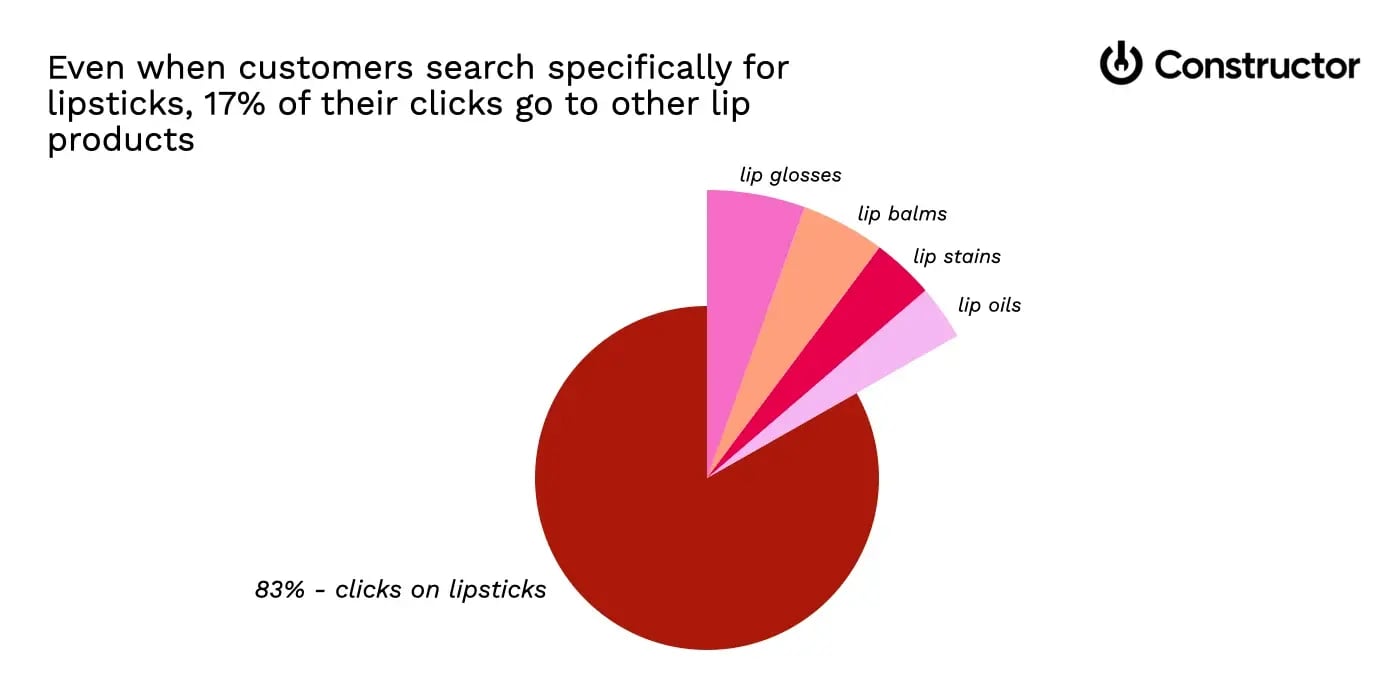
Why it matters to health and beauty: Product attributes provide the foundation for discoverability, but they don't tell the whole story. Constructor's analysis of beauty shopping behavior found that customers searching for "lipstick" often purchased entirely different formats, including lip glosses, oils, stains, and balms: 17% of clicks went to lipstick alternatives. These preferences also evolved over time, with lip balm overtaking lipstick as the most popular format in the retailer's analyzed data. A discovery system that learns from actual purchases can identify these changing relationships without relying exclusively on manual product tagging or predefined synonyms.
Pillar 3: Pair Personalization with Recommendations to Make Online Store Results More Attractive
The commercial case for personalization is strong and has been for a while, with McKinsey research showing that effective personalization can boost sales by 10–15%, with company-specific results ranging from 5–25%.
But "effective" is the key word. Personalization applied without a clear KPI objective and measurement loop frequently underperforms. Or worse: it drives engagement that never converts to online sales.
For health and beauty ecommerce websites, personalization addresses the substitutability problem directly. When 10 foundations are technically relevant to a query, behavioral signals — what similar shoppers have purchased, what this shopper has clicked on before, and what correlates with their skin type or shade range — help surface the two or three most likely to convert. The goal is to make the next-best option obvious, beyond whatever a shopper has already seen or bought.
And when it comes to recommendation engines, effective ones combine collaborative filtering (what similar customers bought), content-based matching (by skin type, ingredients, shade compatibility), and margin-aware business rules (inventory and profitability boosting). Proper placement is part of a broader recommendations plan, with touchpoints spanning the search results, category pages, PDPs, cart, and post-purchase email.
Why all of this matters to health and beauty: The opportunity goes beyond personalizing results based on past purchases or shopper segments. Constructor's research into millions of beauty searches demonstrated that identical queries can represent very different preferences. One shopper searching for "red lipstick" might prefer a deep berry gloss, while another wants a matte brick-red lipstick. Constructor's reinforcement learning technology uses real-time behavioral signals — including clicks, add-to-carts, and purchases — to continuously refine product ranking and adapt to what shoppers actually buy, rather than relying on keyword relevance alone.
How to personalize experiences for every beauty shopper
Apply personalization at these touchpoints:
- Search ranking: rerank results based on behavioral affinities and cohort behavior
- Category and PLP ranking: surface the items most likely to engage and convert in this session
- PDP recommendations: "Complete the routine," "Others also bought," "Similar shades in your range"
- Cart recommendations: cross-sell at basket stage (complementary products, travel sizes, replenishment)
- Post-purchase: replenishment timing nudges, routine expansion suggestions
Build in guardrails so personalization doesn't work against you:
- Ensure result diversity: don't let personalization collapse results into a single brand or product type
- Apply inventory and margin constraints so the system doesn't personalize toward out-of-stock or low-margin items
- Build freshness controls so new products get exposure before they accumulate behavioral history
Also, define the KPI before enabling personalization at any touchpoint, and run controlled A/B tests to measure lift. Personalization that improves CTR but hurts conversion rate or margin is a net loss. Continuous optimization — testing, measuring, iterating — is more durable than any single configuration.
What to measure
Watch these metrics to confirm personalization is earning its keep:
- CTR on recommendation carousels by placement and algorithm variant
- Assisted conversion rate (sessions that interact with a recommendation and convert)
- AOV lift from recommendation clicks vs. non-recommendation sessions
- Repeat purchase rate for shoppers exposed to post-purchase personalization
Why A/B testing matters to health and beauty: Not all recommendation strategies deliver the same commercial outcomes. In Constructor's internal A/B testing, alternative-product recommendations increased the number of users clicking recommendations by 8.1%, while complementary-product recommendations produced an 11.6% improvement in users clicking and then adding to cart, and a 13.6% improvement in clicks followed by a purchase. For beauty retailers, this reinforces the importance of testing complementary recommendations — such as pairing a foundation with a primer or lipstick with a lip liner — rather than optimizing for recommendation clicks alone.
Pillar 4: Invest in Beauty Industry-Specific Experiences
Beauty purchases carry higher uncertainty than most ecommerce categories. A shopper buying a foundation shade they've never tried — or a skincare ingredient for the first time — needs confidence as much as accurate search results.
The same discovery investment that works for apparel won't be enough in beauty. You need capabilities that address beauty's core anxiety: Will this shade match my skin tone? Will this formula work for my skin concerns and type? What does it actually look like in real life?
In this category, reducing that uncertainty is what actually drives conversion. Surfacing relevant options alone won't do it.
How to implement value-added beauty features
Invest in high-quality visual commerce that shows products realistically:
- Shade swatches that show product color on a range of skin tones, not just on a white background
- Before/after professional, high-quality images for skincare product claims (texture, finish, coverage)
- User-generated content (UGC) surfaced on PDPs and in search results for social proof and real-world context
- Video demonstrations for application technique, texture comparisons, and shade-on-skin previews
Use shade-matching quizzes to narrow down options fast: Build quiz flows that map shopper answers directly to product attributes. A four-question quiz (skin tone range, undertone, coverage preference, finish preference) can narrow a 200-SKU foundation range to 10–15 high-confidence options — and pass session context to search and recommendation ranking so the entire subsequent experience reflects customer preferences.
Add AR try-on for color cosmetics where shade is uncertain. Virtual try-on has become a mainstream expectation over the past decade. L'Oréal's integration of ModiFace with Facebook's Spark AR brought AR-powered makeup try-on directly into commerce experiences, proof that this technology has moved well beyond dedicated apps and into core discovery workflows.
Even consider installing a 24/7 online associate right on the product detail page (PDP) to ensure high-intent shoppers don’t bounce at the finish line. Beauty shoppers can get trustworthy answers to their final-product questions, crushing any uncertainty before buying.

What to measure
Use these metrics to see whether quizzes, agents, and try-on are building real confidence, not just getting customers engaged:
- Try-on activation rate (activations per PDP visit for SKUs with try-on enabled)
- Quiz completion rate and conversion rate for quiz-guided shoppers vs. direct browse
- PDP engagement depth (image views, video plays, UGC interactions) as a proxy for confidence-building
- Conversion rate lift for sessions with quiz or try-on interaction vs. control sessions
Pillar 5: Marry Performance + Merchandising Ops + Measurement
Technical performance and operational efficiency are the unsexy parts of product discovery, yet they’re the ones most likely to undermine everything else if neglected.
Regarding performance, Deloitte and Google research found that a 0.1-second improvement in mobile site speed increased retail conversions by about 8.4% and average order value by 9.2%. Search results pages, category pages, and PDPs are your core discovery touchpoints. If they're slow, every investment in relevance, enrichment, and personalization is partially wasted. Most customers won't stay long enough to benefit.
On the ops side, discovery improvements compound only if your merchandising team can move quickly. They need to understand what's working — and build on it. A team spending 80% of capacity on manual synonym fixes and promotion swaps has no bandwidth for strategic optimization. Measurement without action is documentation, not improvement.
How to optimize beauty website performance
Keep your discovery pages performing well:
- Monitor Core Web Vitals specifically on search results pages, category/PLP pages, and high-traffic PDPs (not just the homepage)
- Optimize image loading for swatch-heavy pages (lazy loading, next-gen formats, appropriate compression ratios)
- Set performance budgets and alerting thresholds so regressions are caught before they affect conversion at scale
Give merchandisers direct controls over key surfaces:
- Implement pin and slot capabilities to surface hero products, campaign launches, and seasonal items without relying entirely on ranking algorithms
- Build rule-based boosting for promotional priorities (new arrivals, top margin items, brand partnerships)
- Use timeboxing to automatically expire promotional rules so that last season's campaign hero doesn't persist into next quarter
- Enable bulk rule management so changes can be applied across a category or collection without editing individual SKUs
Set up a recurring optimization loop:
- Weekly: Review no-results queries, top query reformulations, and search conversion by query type
- Bi-weekly: Audit merchandising rule performance (Which rules are improving conversion? Which are neutral or negative?)
- Monthly: Review facet usage, attribute coverage gaps, and recommendation CTR by placement
- Quarterly: Evaluate KPI performance vs. baseline; plan next round of A/B tests
What to measure
Keep an eye on these metrics to make sure performance and merchandising ops are holding up their end:
- Core Web Vitals (LCP, INP, CLS) on search results and category pages
- Time-to-results: how long between query submission and results render?
- Conversion rate by discovery entry point (search vs. browse vs. recommendations)
- Merchandising rule impact: percentage of active rules with measurable positive vs. neutral/negative conversion effect
- Time-to-launch for new campaigns or category updates (a proxy for merchandising efficiency)
A 90-Day Product Discovery Roadmap for Online Beauty Brands
By taking the right steps, you can optimize your cosmetics brand’s online store within three months.
Days 0–14: Audit + baseline
Your goal during the first two weeks is to establish your baseline before you touch anything. This means:
- Pull your top 100 search queries and categorize by query type (brand, ingredient, shade, concern, symptom, thematic)
- Identify your top 20 no-results queries and top 20 high-reformulation queries
- Audit product attribute coverage for your top 5 beauty categories: what percentage of SKUs have complete shade, skin type, finish, and key ingredient data?
- Run a Core Web Vitals audit on your search results page, top 3 category pages, and top 10 PDPs
- Establish baseline metrics: search usage rate, no-results rate, search conversion rate, and overall conversion rate by discovery entry point
Days 15–45: High-impact quick wins
During the next month, work on fixing the most common failure modes with targeted, measurable interventions.
- Build synonym maps for your top no-results queries (start with 20–30 high-volume terms)
- Implement redirect rules for zero-results queries that have an obvious category destination
- Enable or audit typo tolerance and autocomplete coverage for health and beauty-specific terminology
- Add or correct shade family and undertone attributes for your top-selling color cosmetics SKUs
- Identify and close the worst attribute gaps in your top 2 categories
- Optimize image loading on your highest-traffic category and search results pages
- Establish a weekly no-results and reformulation review cadence with clear ownership
Days 46–90: Compounding improvements
The last half of the sprint should be dedicated to building the capabilities that generate durable, compounding returns.
- Pilot behavior-informed enrichment for one category: use clickstream data to surface product relationships your current attribute taxonomy is missing
- Launch an A/B test on PDP recommendations (test one algorithm variant against the current default, measured on conversion rate and AOV)
- Evaluate or implement AR try-on for your highest-uncertainty SKUs (foundation, concealer, lip color)
- Build or refine a shade-matching quiz for your top color cosmetics category and connect quiz outputs to search and recommendation ranking
- Instrument merchandising rule tracking: tag each active rule and measure its conversion impact at the 30-day mark
- Enable personalized category ranking for your top 3 traffic-driving PLPs
The Path Forward Is Clear
Beauty product discovery is a system problem with a system solution. The five pillars — site search, product data, personalization, health and beauty-specific experiences, and performance plus merchandising ops — reinforce one another rather than operate as independent projects.
Improve attribute coverage, and you immediately improve search ranking, filter utility, recommendation accuracy, and AEO efforts. Better behavioral signals improve both personalization and data enrichment priorities. Performance improvements ensure every other investment actually reaches the shopper.
Retailers who see compounding improvements keep optimizing discovery on an ongoing basis rather than treating it as a one-time redesign. That means measurement loops, regular review cadences, and controlled tests at every stage.
Here is your quick-start checklist:
- Audit your top 100 search queries for query-type coverage gaps
- Measure no-results rate and identify your top 20 zero-result queries
- Evaluate attribute coverage for shade, skin type, and ingredient data across top categories
- Run Core Web Vitals on your search results, category, and PDP pages
- Choose one primary KPI to optimize toward (conversion rate, revenue per session, AOV, or gross margin)
- Set up a weekly review cadence for search analytics with clear ownership
This roadmap is a starting framework. The right sequence depends on where your biggest gaps are today. Start with the audit (you can't prioritize what you haven't measured), and once you know your baseline, every improvement becomes a data-backed decision rather than a guess.