
Introduction
The Reason for Reasoning
For digital shoppers, search is a step towards a decision, not a document retrieval mission.
Shoppers don't need to see more products, they need help choosing.
The problem is, traditional ecommerce search engines can only function as document retrieval systems — even when they're "powered by AI." They're unaware of which products in the catalog perform well for a given query. They're unable to reason over which products should be excluded from results. And they lack insight into how the shopper is behaving within their current session.
Behavioral data — when used by a traditional ecommerce search engine — only impacts how products are ranked, not how they're chosen from the catalog. When the ranking system receives the wrong set of products, it must still show them all to the shopper, whether they really match the query's meaning, satisfy the shopper's intent, or are likely to be purchased.
Applying AI-modeled 'relevance' to unsuitable and unpopular products doesn't drive revenue.
A reasoning engine that learns from behavior can make smarter judgment calls at every stage:
- What the query means — based on what shoppers do after submitting similar queries
- What to retrieve — which individual products, categories, and related items get clicked and bought for similar query-product pairs
- How to rank — for the individual shopper, based on their history, their in-session behavior, and learned signals from shoppers like them
To illustrate the impact, let's follow the journey of a query through both types of discovery systems: the AI-enhanced search engine, versus the AI-native reasoning engine.
Chapter 1
The Query Journey, Defined
To understand how the query journey veers off course when a search engine can't reason over behavior, we need to look at how search engines fundamentally operate. No matter how advanced a platform claims to be, search engines follow the same basic flow:
- Try to understand what the shopper typed (interpretation)
- Find the best set of products that match the query (retrieval)
- Sort those products in some kind of order (ranking)
That's it.
Some search engines have improved these processes by incorporating:
- Natural language search — interpreting words more flexibly instead of exact matches
- Vector (semantic) search — finding products that are mathematically similar in meaning, even if the words don't match, and
- AI/machine learning — reordering results based on what people have clicked or bought before.
Without behavioral context and end-to-end reasoning, even the most mature search engines rely on just two capabilities: language and math. And that's precisely what prevents them from fully satisfying a shopper's intent and preferences.
Natural language search maps the query against a dictionary of related terms; statistical scoring determines which relationships are close enough to count. But that scoring is not trained on live shopping behavior, it's based on patterns in language: how words co-occur, how frequently terms appear, and how they relate to each other in general. This leaves plenty of opportunity for the system to miss the mark.
Vector search converts language into numerical representations (embeddings), and math measures the distance between the query and product vectors to find the closest matches. But when query interpretation is already off-track, the engine retrieves the wrong candidates — and has no way to reason over which results actually belong.
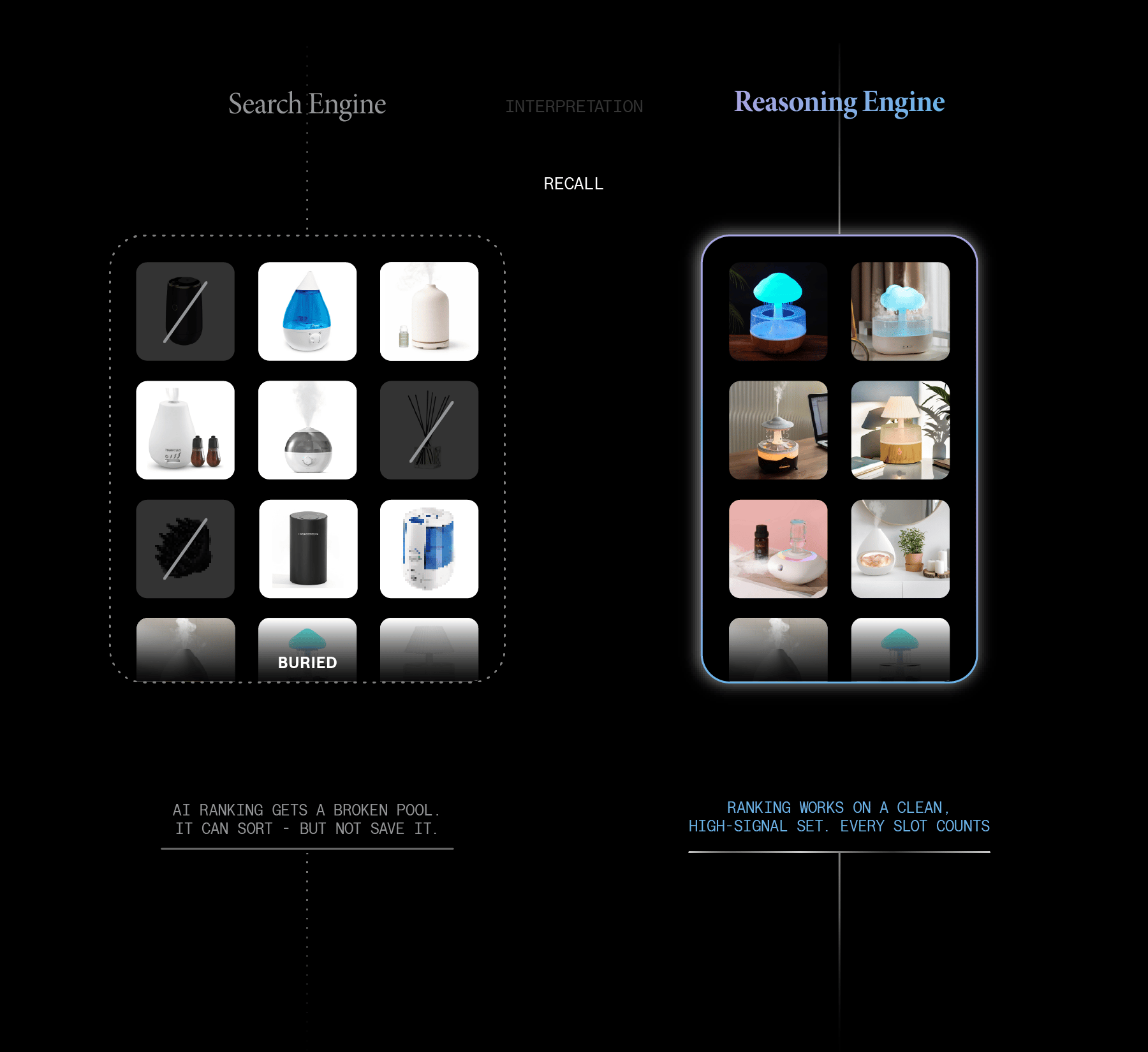
Machine learning can apply behavioral data to reorder results, using signals like clicks, add-to-cart actions, and purchases to promote what has performed well in the past. But this optimization happens only at the ranking stage — because it isn't applied at the retrieval stage, the system can only reshuffle the products it was given. When ranking receives poor matches, an AI model can't remove them, it can only bury them in the results.
End-to-end, the search engine can only organize by generic understanding of meaning and relevance — it lacks the behavioral feedback loop to optimize the discovery experience.
The query journey through two engines
Let's follow an example query — "rain cloud diffuser" — across each stage of its journey, through both types of discovery engines: search and reasoning.
This TikTok-viral product is technically classified a "smart humidifier diffuser" — an IoT-enabled tabletop device that combines air humidification with aromatherapy, controllable via smartphone apps or voice assistants. But even that more precise term is an ambiguous search query.
There are such things as smart humidifiers that don't diffuse, smart diffusers that don't humidify, and humidifier-diffusers that aren't smart! And there are all sorts of products that are just plain diffusers, humidifiers, or smart in some way.
A smart discovery system needs to properly decipher what "rain cloud diffuser" most likely means, determine which products qualify as strong matches (and which should be excluded from results), and rank each match in the best order for the shopper.
What happens when this query moves through both types of discovery engines?
For the shopper, the difference plays out in seconds. For the retailer, it plays out in revenue.
Chapter 2
Interpretation: What's the Shopper's Intent?
The shopper hits submit, the journey begins.
Here's where things start off right or go sideways. How does the engine figure out what the shopper means and wants by "rain cloud diffuser"?
Query interpretation through the search engine
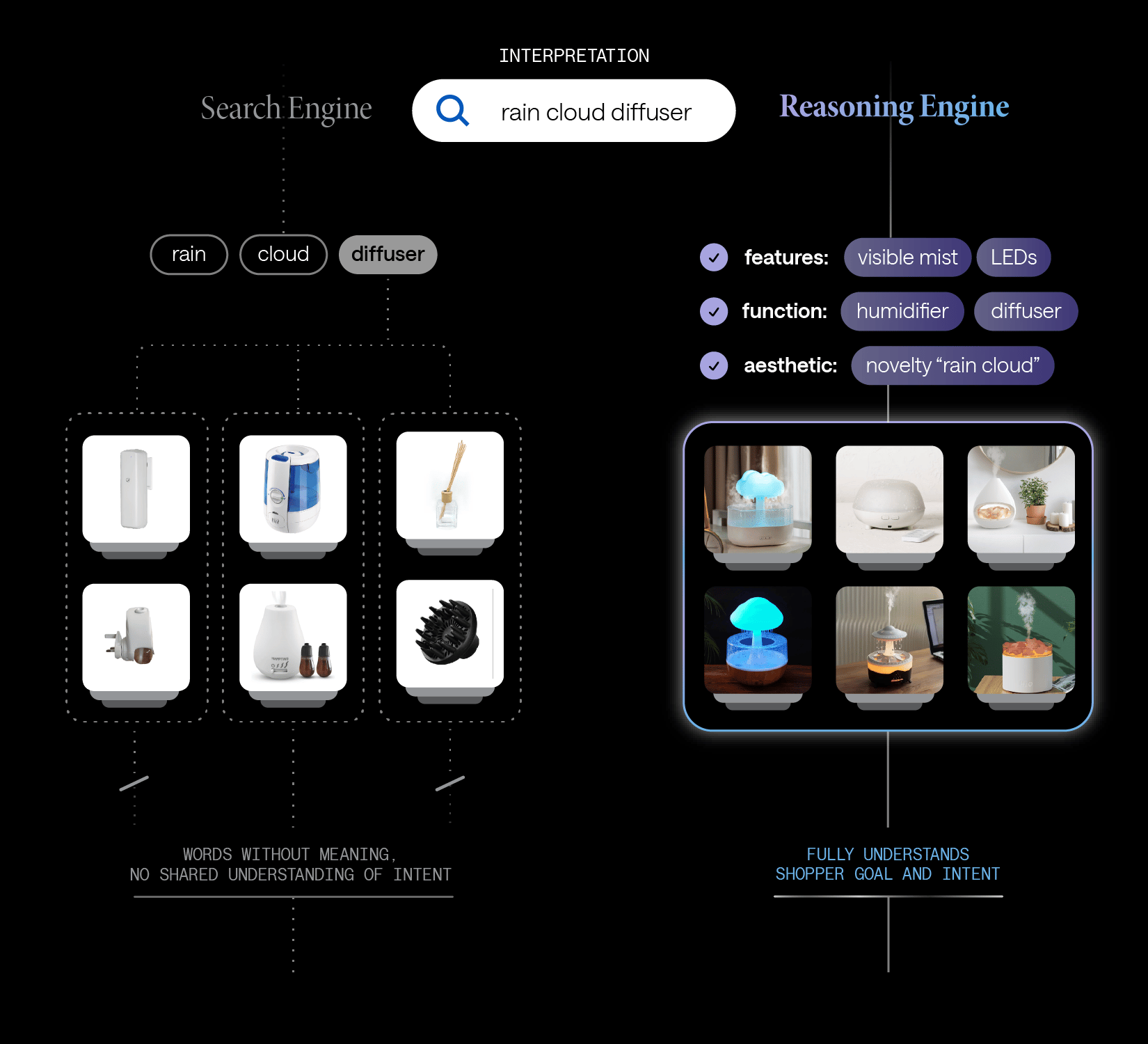
The search engine takes the query and breaks it into individual terms:
From a keyword standpoint, "diffuser" is the only clearly defined product signal. "Rain" and "cloud" don't map cleanly to a standard product taxonomy — they're descriptive, not categorical.
So the system has to decide: Are these attributes, modifiers, or just noise?
A basic keyword-driven engine will anchor on what it recognizes. In this case, that's diffuser. Everything else becomes optional. So it starts forming interpretations like:
But none of these are standardized product categories. There's no canonical "rain cloud diffuser" class in the catalog.
If the search engine is "semantic," it will try to interpret meaning beyond exact terms and expand the query into related concepts:
But instead of improving its understanding, the search engine has drifted even further from what that shopper actually wants. This search term hasn't been around long enough to exist inside its general map of natural language, so it falls back on text matching and takes the query "too literally."
Query interpretation through the reasoning engine
The reasoning engine has a clear advantage over the search engine — it has visibility into what shoppers actually do after they submit search terms like this:
- What types of products get clicked (and don't), from what categories, and with what shared attributes?
- How do shoppers revise their queries when they don't click the first set?
- What filters and facets do they apply?
- What browse pages do they pull next?
- What recommendations are most often clicked?
- And what do shoppers actually end up buying?
For example, the behavior patterns around "rain cloud diffuser," "cloud humidifier," and "rain mist diffuser" may show that shoppers tend to ignore generic diffusers, and gravitate towards products that share cloud-like shapes, have mist effects, and feature ambient lighting.
The reasoning engine determines that "rain cloud diffuser" most likely means "a visually distinctive novelty device" that combines:
Even if this exact phrasing hasn't been used on the retailer's site before, the reasoning engine's continuous training across multiple retailers can leverage both the language and the behavior patterns that point to its meaning, and shopper intent.
Reasoning in real time
But it's not just the macro signals that influence interpretation. What shoppers do on the retailer's own site — and what the individual shopper is doing now — are very important signals.
In-session behavior represents the prequel to the query — what did the individual shopper do leading up to the search box within the session?
- Were they already viewing a "matching" product and looking for more options to compare?
- Were they browsing the Aromatherapy category and didn't click?
- Do they have a specific brand of essential oils in their wishlist or cart?
With these real-time insights and the ability to think over them, the reasoning engine understands what "rain cloud diffuser" means, and carries signals into the retrieval step that reflect that — a small, decorative diffuser with humidifier feature, visible mist, ambient lighting, and a cloud-like form factor.
The traditional search engine, by contrast, just passes on a rewritten keyword string — "cloud diffuser" — which carries no true meaning for retrieval.
What the engine understands now determines what it will retrieve next.
Chapter 3
Retrieval: Why Shopper Behavior Matters
The query now moves to the most critical step — retrieval.
Through a process called recall, the engine controls what the shopper can find within results.
Will they need to scroll through irrelevant products? Will they have to reformulate their query? Will they give up and try their luck elsewhere?
Or will the results hit.
Recall through the search engine
The search engine already starts with a disadvantage — a simplified version of what the shopper's query meant. It then proceeds to apply its language-and-math tools to find eligible candidates.
First, it looks for direct keyword matches — products that contain the same terms, or close variations in titles, descriptions, attributes, or whatever product data it's able to index. If it has semantic capabilities, it will try to retrieve semantic matches (related to the query), checking for products that might also be relevant in some way to broaden the candidate pool.
Depending on how strict the matching logic is, you can get one of two outcomes.
If rules are tight and require all terms to appear together (rain + cloud + diffuser), it will exclude all smart humidifying diffusers that don't explicitly contain rain or cloud. This can very likely lead to 'no results found.'
If rules are looser, it can include products simply because they match rain, cloud, or diffuser, regardless if they're smart or humidifying — or if they're even diffusers at all.
And, if like many semantic search engines, it's been trained to retrieve anything that looks close enough to the query string, it may recall any number of products that really shouldn't be part of the results set. For example, reed diffusers, diffuser oils, plug-in air fresheners, rain boots, and anything with a cloud print.
In every case, the search engine retrieves a problematic product pool that gets pushed onto the ranking phase.
Recall through the reasoning engine
In contrast, the reasoning engine has several mechanisms to prevent recall pool pollution.
Because it starts with a more complete understanding of the query, it has a better set of criteria for product retrieval. It still pulls products based on similarity — in this case, how closely they align to "small, decorative diffuser with humidifier feature, visible mist, ambient lighting, and a cloud-like form factor" — but it doesn't stop there.
From catalog data, it also reasons over what similar attributes it finds that might still be acceptable to include (or even preferred, once discovered by the shopper), such as mushroom, umbrella or UFO-shaped diffusers (yes, they DO exist), or smart diffusers that may not include lighting effects. If real shoppers ultimately buy any shape of smart humidifying diffuser, or even occasionally choose a "dumb" one absent any smart options, it can expand recall to include these options.
After this round of retrieval, the engine then applies its reasoning model to filter products that are unlikely to be clicked or purchased, based on real shopping data. The cleaned set of qualifying products are then scored as a weighted sum of how relevant and attractive each product is in relation to the query and the shopper.
This score is based on four facets:
- Base score: Overall popularity and how closely the item matches the query
- Group attractiveness: How the product's category and attributes have historically performed for similar queries
- Item attractiveness: How the specific item historically performed for the query
- Personalization: How the product is likely to match the individual shopper's preferences based on their known attributes and clickstream history (including the present session), matched to behavior from "shoppers like them"
Now ranking has both a clean recall set and a quantitative understanding of how relevant and attractive each item is to the query.
Chapter 4
Ranking: AI Can't Clean a Dirty Product Pool
Now for the moment of truth.
How will each engine present products to the shopper? Will results overwhelm and confuse, or will they provide decision support?
Ranking by the search engine
While search engines have varying degrees of technology, let's assume this one's a Cadillac — AI-powered ranking that incorporates behavioral clickstream, product performance data, and machine learned relevance scoring — the best of what traditional search has to offer.
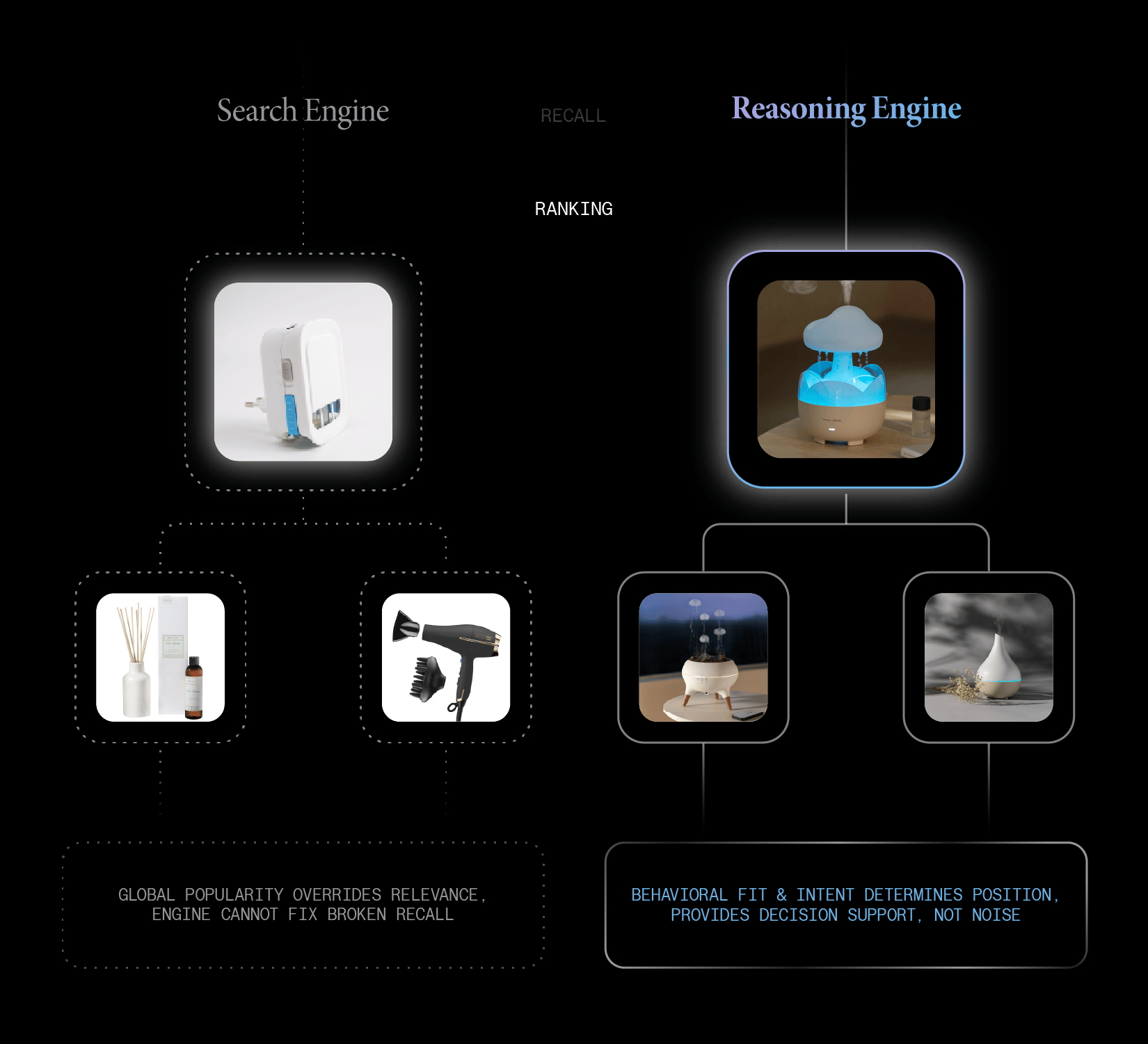
Despite these capabilities, the ranking system is already set up to fail. It has received a set of products from the retrieval stage that includes strong matches, weak partial matches, and completely irrelevant products — and it must work with them all.
The system must now balance competing ranking factors across a broader set of products:
- Textual relevance scores
- Searchandising rules, such as boosted brands, categories, and products
- Popularity scores, such as click-through and sell-through rates (often captured at the global level, not query-product specific)
- Contextual factors, such as stock status, inventory levels, and seasonality
- Personalization signals, when available
More products to score = more ranking factors to apply — and more opportunity for signals to clash. The highest scoring products can have low relevance to what the shopper actually meant. And because query interpretation wasn't based on behavioral learning, textual relevance is also more fuzzy than it should be.
The result: the shopper sees pages of products that don't seem to make sense.
The best illustration of this problem is a live search for "rain cloud diffuser" on any home goods or big box retailer. Take a moment to try it. You'll clearly see what a typical search engine thinks could pass for "relevant."
Don't be surprised if you find multiple pages of results that reward completely irrelevant results with high rankings, such as:
- Plug-in air fresheners
- Plug-in scented oil diffusers
- Glass reed diffusers
- Battery-operated aromatherapy dispensers
- Textured ceramic diffusers
- Warm moisture humidifiers
- Scented oil plug-in diffuser refills
- Quick styling hair dryers (with diffuser attachment)
- Plastic mister spray bottle
- Cool mist top-fill room humidifier
- Swiffer duster starter kit
- Flameless candle diffuser
- Meditative fidget stones with essential oil blend
- Steam floor mop
- Aromatherapy bracelets
- Car diffuser with travel case
- Ultrasonic smart humidifiers
- Room spray
These are real product matches a top-ten retailer returned for this query. Of 360 product results across 15 paginated pages, only a handful of smart humidifying aromatherapy diffusers with ambient lighting effects appeared, scattered in random slots behind page 4.
For shoppers, weeding through the clutter is simply too much friction.
Global popularity — a blunt ranking factor
One of the most problematic ranking factors is global popularity — a signal that algorithms over-weight, even though it says nothing about how the product performs in the context of the specific query, the shopper, or the products it's shown alongside.
When there's not a perfect text match in the recall set, low-ticket, fast-moving consumer goods like plug-in air fresheners and their refills bubble to the top of results, while slower-moving (but highly relevant matches) get buried under the clutter.
Even if the ranking engine could perfectly order results by true relevance and appeal-to-the-shopper, the moment the shopper touches a sort-by option or applies a filter through faceted navigation, irrelevant products the system managed to bury can rise to the top.
Large result sets dilute behavior signals
Over-recalled product sets create a trickle-down problem: they dilute the engagement signals the AI model depends on to learn.
When shoppers abandon search (or the website) after seeing poor matches rank highly, they never see or click the could-be-appealing options downstream. The system registers that the query performs poorly, without associating that performance to the real cause — too many irrelevant options in the result set.
Besides this, there are several more reasons that behavioral signals barely improve results for traditional search rankers. We'll explore those in depth in the next chapter.
Ranking by the reasoning engine
The reasoning ranker starts with a significant advantage: a product set that has already been filtered for relevance and likely performance.
The retrieval model has weeded out:
- Standard humidifiers, diffusers and smart-home objects
- Smart humidifiers that don't diffuse
- Smart diffusers that don't humidify
- Humidifier-diffusers that aren't smart
And it's captured products that may not include "rain cloud" but fit the behavior-shaped query interpretation:
- Humidifying aromatherapy diffusers with light display
- Humidifying aromatherapy diffusers with novel shapes
Now the reasoning ranker can apply all the usual ranking factors — textual scores, popularity signals, searchandising rules, and personalization — but with something the search engine lacks: the ability to think like a shopper when deciding how to rank products.
For example, it can infer that "rain cloud" is the qualifying attribute that signals intent because it describes a unique, novelty aesthetic that differentiates it from ordinary models. Based on deep learning across millions of shopping interactions, it recognizes that intent can be flexible when alternative products reflect the primary buying criteria — even if they don't match it exactly.
It can boost alternatives like a jellyfish or teardrop shape may still be attractive to the shopper if given the opportunity to discover them. Similarly, the model understands that intent can shift when alternatives are offered. A teardrop-shaped diffuser with visible Himalayan salt crystals may be chosen over a cloud-shaped version of a more basic diffuser — and historical clickstream informs those ranking decisions.
But we're only scratching the surface. In practice, an intelligent ranking system weighs many granular factors to determine the final order each shopper sees. How it weights them is a function of how the AI model learns from the data it receives, how it's trained, and how frequently it's updated.
In the next chapter, we'll look at behavior's role in ranking — and why "behavioral ranking" means very different things depending on how that data is captured and applied, both in relation to the query and the shopper.
Chapter 5
Shopper Experience: Behavior Shapes It or Breaks It
The differences we've seen so far aren't just about AI models and ranking factors. They boil down to how each system captures behavioral data and where it gets applied.
Behavioral data spans every interaction a shopper has along the journey — from how they arrived on the site, what they browse before searching, how they refine queries, what they click, scroll past, or ignore — and ultimately what they add to cart, remove, or return to later.
When you compare how search engines get and use behavior against the reasoning engine, the differences are significant and have real implications for shopper experience and revenue.
The limitations of search engines
The primary problem for search engines is behavior is only applied in one area: ranking. It's unable to use it to fully interpret shopper intent at query-time, or understand query-to-product performance during recall.
But it goes deeper — the behavior data itself is fundamentally compromised.
Patched-and-batched clickstream
For most search platforms on the market, behavioral data is not captured by the search engine itself. Events are captured from other sources, such as analytics, the commerce platform, or the CRM system, and patched into the search engine on a batched schedule.
These batch runs may happen once a day, once a week, or even less frequently. The AI ranking model is only re-trained on this batch schedule, leaving a freshness gap that can impact the quality of search results for some queries.
Batched behavioral data is never in-step with the shopper. The system doesn't know if a current promotion is driving more sell-through. It's never aware if the shopper's recent visit contained valuable signals to personalize against. It can never leverage in-session behavior to optimize for real-time intent — which can often change while they are still shopping, as they interact with search, discover recommendations, and compare products.
Dirty clickstream
To compound the problem, behavior data captured by third-party systems is rarely clean — it frequently contains bot traffic, duplicated and misattributed sessions, and missing events from inconsistent tracking.
In many cases, the system is also working from only a partial view of behavior. Signals are captured unevenly across touchpoints, leaving gaps in how shopper intent is represented — especially for edge cases, long-tail queries, and emerging trends.
This pollution distorts behavior patterns that the AI model accepts at face value. The model learns noisy rules from a noisy data stream, and applies them to ranking.
Because this data is rarely verified against actual business outcomes — such as conversion or revenue impact — these issues can persist undetected, and the system continues to reinforce patterns that don't reliably translate into results.
Fragmented data
AI models can't learn from clickstream actions across the shopper journey without a unified learning loop. When a retailer uses different systems for search, recommendations, browse-page merchandising, and AI shopping assistants, it's impossible to follow clickstream end-to-end — the signal will always drop somewhere, meaning aggregated clickstream is far less reliable.
For a query like "rain cloud diffuser," the model has no way to learn what acceptable substitutes look like unless they're clicked directly from search results — if they make it into results in the first place.
Likewise, these siloed surfaces never learn from search behavior. AI models within browse, recommendations, and AI assistants can only work from their own observations.
Synthetic data
Some platforms attempt to work around their lack of native clickstream capture with synthetic behavioral data, modeling how shoppers might behave under various conditions. Because they rely on simulated patterns rather than observed behavior, they simply can't accurately reflect the vast number of ways that shoppers actually interact with products in real contexts. Decisions based on assumptions rarely translate into reliable results and revenue.
The advantages of the reasoning engine
The reasoning engine has an architectural advantage over traditional search: it captures behavioral data natively across every discovery touchpoint.
Clickstream isn't collected separately across search, browse, recommendations, and AI shopping agents. It's not batched in on a delayed schedule. And it's not bloated by bot traffic, and duplicated sessions, or brittle from tracking issues.
More complete behavioral data means the reasoning engine can make stronger decisions across every step of the query journey — and the entire shopper journey, beyond search.
Unified clickstream
Native, end-to-end clickstream capture means the reasoning engine has access to all meaningful on-site interactions, in context. It can associate clicks, scroll patterns (including dwell time signaling interest, and pauses that signal hesitation), save-to-favorites, add-to-carts, remove from carts, query refinements, and surface-switching.
Do shoppers abandon search results and start browsing? Do they engage with recommendation pods on product and cart pages? All this cross-site behavior is associated back to the query, shopper intent, and products — which products had impressions, where they were shown, and in what positions.
This creates a more complete and reliable feedback loop. Because that loop is continuous across all shopper sessions, the model continually updates itself based on fresh, human signals through reinforcement learning — a method that improves decisions based on what actions lead to positive results.
Verified clickstream
The feedback loop depends on accurate data. If shopper actions are frequently duplicated, out of sequence, or incorrectly attributed across users, sessions, or devices, the model doesn't learn from what actually happened, it's skewed by messy signals.
A verified clickstream cleans and normalizes click patterns so that each interaction represents real shopper behavior. Bot traffic is removed, events are de-duplicated and ordered correctly, and sessions are reconciled across devices.
In-session behavior
Native clickstream capture means behavior can be observed and leveraged in real time — no need to wait hours, days, or even weeks for a patchy batch job.
This means the reasoning engine is aware of what the shopper did before submitting the query — how they entered the site, their pre-query clicks and scrolls, the browse pages they visited, the filters they applied, even the queries they recently searched — all within the active session.
For our query case, ranking order may differ for a shopper who's already viewed several diffusing humidifier product pages before submitting the query, versus one who's already browsed the Diffusers category without clicking anything on the first page.
What the shopper does after seeing search results further refines the shopping experience. Product recommendations, browse page sort order, next-search ranking, and conversational AI all stay in lock-step.
Mapping the shopper's real-time micro-behaviors to patterns within the broader clickstream enables the system to pinpoint and predict next-actions more sharply — and even extend them off-site to email, SMS, and in-store experiences. It's personalization on steroids.
Behavior signal breakdown
Because of their architectural limitations, search engines can't capture all the behavior signals that matter. This means their AI models only learn from certain patterns, not the full picture. Only the reasoning engine captures behavior from all discovery touchpoints, and applies this learning across the full query journey — from query submission to final ranking.
| Behavioral signal | Traditional search engine | Reasoning engine |
|---|---|---|
| Pre-site search terms (referral intent) | Not typically captured or connected to search | Captured and used as part of session context |
| Pre-query browsing behavior | Limited or siloed (analytics, not tied to search ranking) | Captured in-session and directly influences results |
| Clicks on search results | Captured and used (often batched) | Captured natively and used in real time |
| Time on page | Captured in analytics, rarely used in ranking | Captured and incorporated as engagement signal |
| Scroll depth | Tracked separately (analytics), not connected to ranking | Captured and used as part of behavioral signals |
| Query refinements | Captured in search logs, limited contextual use | Captured as part of evolving intent within session |
| Clicks on recommended products | Typically siloed in recommendation engine | Unified across surfaces and connected to search behavior |
| Navigation paths (menu/browse) | Captured, but not connected to search ranking | Fully connected as part of journey-level behavior |
| Add to cart/purchase | Captured and used (often aggregated) | Captured and used with full context and attribution |
| Remove from cart/favorites | Inconsistently captured or used | Captured and used as negative signal |
| Repeat visits to pages/products | Tracked, but weakly connected to ranking | Captured and used to reinforce intent |
| Product attribute preferences (implicit) | Inferred indirectly, often weak signal | Learned directly from behavior across sessions |
Summing it up
The behavioral data gap isn't a configuration problem. It's an architectural one.
Search engines weren't built to capture, clean, and continuously apply behavioral signals across every stage of the shopper journey. No amount of integrations or synthetic workarounds resolves that constraint — it's baked into how these systems were designed. AI models trained on fragmented, delayed, and polluted data are always working from a partial picture, optimizing against a version of reality that lags or distorts what shoppers actually did.
The reasoning engine starts from a different premise: that the quality of the feedback loop determines the quality of everything downstream. When behavioral data is native, clean, continuous, and connected across every discovery touchpoint, the model gets sharper with every session. The system learns from real shoppers, in real time, and applies that learning where it matters — at the query, on the page, and across the journey.
This is the variable that rarely shows up in vendor comparisons. It's not just which AI model powers ranking. It's what that model is learning from — and whether that data reflects what actually happened.
The next chapter is a framework for evaluating exactly that.
Chapter 6
The Reasoning Engine Test
Most search platforms today claim to use AI, personalization, and machine learning.
But the reality is that these capabilities are merely bolted on to the ranking stage, and behavior doesn't influence query interpretation or product recall.
If you're unsure whether your existing platform (or one you're currently evaluating) is AI-washing the query journey, this acid test will give you clues.
You can run these tests directly on your site — or ask your vendor to explain how their system would perform in each scenario. In many cases, how they answer will tell you as much as the results themselves.
How to use this test
Each section includes:
- What to do
- What to look for
- How systems typically behave
- What to ask your vendor
You don't need access to the underlying architecture. You're observing behavior — and using that behavior to infer how the system is built.
1. The Messy Query Test
What to do: Search for a multi-word query that combines product type, attributes, and intent. For example: "vegan frozen dinner," "toner for rosacea," or "princess theme party favors."
What to look for: Are the results cohesive and specific, or broad and loosely related?
Search engine behavior: Anchors on the strongest product term (e.g. "toner"), treating other terms as optional. Results tend to be generic and diluted.
Reasoning engine behavior: Interprets the combined meaning of the query. Results include relevant alternatives that make sense in context, and exclude broad keyword matches.
What to ask your vendor:
- How does your system handle queries that don't map cleanly to existing categories?
- What happens when a query combines multiple attributes or emerging concepts?
- Can you show examples where your system retrieves substitutes, not just matches?
2. The "No Perfect Match" Test
What to do: Search for something niche, emerging, or slightly unusual, where exact matches are unlikely.
What to look for: Does the system fail, or adapt?
Search engine behavior: Returns "no results" or fills the page with loosely related products.
Reasoning engine behavior: Surfaces acceptable alternatives that satisfy the underlying need, even without exact matches.
What to ask your vendor:
- How does your system handle queries with little or no historical data?
- What happens when there are no exact matches in the catalog?
- How are substitute products identified and ranked?
3. The Session Shift Test
What to do: Browse a product list, and apply a few attribute-based filters. Click a few products, add them to favorites or cart. Click a few similar products from recommendation pods on the product page. Then perform a search for the product type.
Example: Browse Fragrance > Perfume. Filter by "Gourmand" scent profile. Engage with a few products with shared attribute (e.g. Vanilla). Perform a search for "fragrance."
What to look for: Does the ranking meaningfully reflect your previous behavior? Tip: Test a fresh search in an incognito window and compare.
Search engine behavior: Results remain largely static, with minimal influence from recent behavior.
Reasoning engine behavior: Ranking shifts based on in-session activity. Products aligned with recent behavior rise to the top.
What to ask your vendor:
- How does in-session behavior influence ranking?
- Is this applied in real time, or after the fact?
- Can recent browsing activity change what appears in search results?
4. The Attribute Tradeoff Test
What to do: Search for something with multiple competing attributes (e.g. aesthetic + function + feature set).
What to look for: Does the system understand what matters most?
Search engine behavior: Applies literal matching or broad similarity. May overemphasize one attribute while ignoring others.
Reasoning engine behavior: Balances tradeoffs between attributes. Surfaces products that best satisfy the overall intent.
What to ask your vendor:
- How does your system handle queries with multiple competing attributes?
- Can it prioritize certain attributes over others based on context?
- How are tradeoffs evaluated when ranking products?
5. The Cold Start Test
What to do: Search for a new product, new category, or low-volume query. Use keywords that don't match the product title exactly.
What to look for: Where does that product rank in search results?
Search engine behavior: Struggles with limited data. Results may be weak or inconsistent.
Reasoning engine behavior: Produces coherent results by leveraging broader behavioral patterns, even with limited direct history.
What to ask your vendor:
- How does your system handle new products or low-volume queries?
- What signals are used when behavioral data is sparse?
- Does the system rely on synthetic data or inferred patterns?
6. The "Does This Make Sense?" Test
What to do: Look at the results across the queries you've tested and trust your instincts.
What to look for: Do the results feel logical and consistent?
Search engine behavior: Frequent "why is this here?" moments. Ranking feels inconsistent or disconnected.
Reasoning engine behavior: Results feel intuitive. The system behaves in ways that align with how a shopper would think.
What to ask your vendor:
- How do you validate that results align with shopper intent?
- Can you explain why specific products appear for a given query?
- How does the system learn from outcomes to improve over time?
What this test reveals
These differences aren't cosmetic — they're structural.
Traditional search engines:
- Sort and optimize within a fixed set
- Rely on fragmented, delayed signals
- Apply logic after the fact
Reasoning engines:
- Evaluate what belongs in the set
- Learn from connected, real-time behavior
- Adapt continuously based on outcomes
These tests are designed as spot checks — a way to quickly observe how a system behaves and infer how it's built.
To validate what you're seeing, we recommend running a structured A/B test against your incumbent solution, measuring impact on conversion, revenue, and engagement. But in many cases, the differences are visible well before you get to that stage.
Final takeaway
You don't need to inspect the architecture to understand what you're working with. You can observe it.
If your system can only sort results, it's a search engine.
If it can evaluate, adapt, and respond in context, it's something more.
Appendix
Vendor Evaluation Framework for AI Discovery
The tests in Chapter 6 focus on observable behavior — what you can see directly in the search experience.
This appendix goes deeper, outlining the architectural differences that drive those behaviors. If you're evaluating vendors, these criteria will help you understand what's happening beneath the surface.
Criterion 1
Data capture model
Search engine:
- Behavioral data is captured externally
- Ingested from analytics, commerce platforms, or third-party tools
- Not owned or controlled by the discovery layer
Reasoning engine:
- Behavioral data is captured natively
- Full clickstream observed directly by the system
- No dependency on external ingestion pipelines
Criterion 2
Data freshness
Search engine:
- Data is batched and updated on a schedule
- Model retraining is periodic
- Decisions are based on historical snapshots
Reasoning engine:
- Data is captured and used continuously
- Models update incrementally or in near real time
- Decisions reflect current behavior, not just past trends
Criterion 3
Data connectivity
Search engine:
- Signals are fragmented across systems
- Search, browse, recommendations, and personalization operate independently
- No unified view of the shopper journey
Reasoning engine:
- Signals are unified across all interaction surfaces
- Full journey visibility (search → browse → recommendation → conversion)
- Behavior is connected and contextual
Criterion 4
Role of behavior in decision-making
Search engine:
- Behavioral data influences ranking only
- Applied after retrieval
- Cannot determine product eligibility
Reasoning engine:
- Behavioral data informs both retrieval and ranking
- Used to determine what belongs in the result set
- Drives eligibility decisions
Criterion 5
Learning model
Search engine:
- Optimizes using aggregated signals
- Limited ability to adapt to new or sparse data
- Learning is constrained by data quality and timing
Reasoning engine:
- Learns from continuous, contextual feedback
- Adapts to new queries and shifting intent
- Learning is reinforced by complete behavioral loops
Criterion 6
Business control model
Search engine:
- Business goals enforced through manual rules
- Boosts, pins, and overrides required
Reasoning engine:
- Business goals defined as optimization objectives
- Model learns toward KPIs over time
- Minimal reliance on manual intervention
Vendor evaluation questions
Don't be shy to ask your vendor these critical architectural questions:
- Is behavioral data captured natively, or ingested from external systems?
- What is the latency between data capture and model availability?
- Are behavioral signals unified across search, browse, and recommendation surfaces?
- At what stage does behavioral data influence decision-making — retrieval, ranking, or both?
- How does the system handle sparse or low-volume behavioral data?
- Are business objectives enforced through rules or learned optimization?
These differences between a search engine with AI bolted on to ranking and an AI-native reasoning engine aren't trivial. They make all the difference to discovery quality, shopper experience, and revenue.
A system that relies on stitched, delayed, and fragmented data will always behave like a search engine, no matter how advanced its ranking model appears.
A system built on unified, real-time behavioral signals has the foundation required to reason.
| Architectural criterion | Traditional search engine | Reasoning engine |
|---|---|---|
| Data capture model | Behavioral data captured externally and ingested from analytics, commerce platforms, or third-party systems | Behavioral data captured natively as part of the discovery system |
| Data freshness | Data updated on a batch schedule; models retrained periodically | Data captured and used continuously; models update in near real time |
| Data connectivity | Signals fragmented across search, browse, recommendations, and personalization systems | Signals unified across all interaction surfaces with full journey visibility |
| Role of behavior | Behavioral data applied at ranking stage only | Behavioral data informs both retrieval and ranking decisions |
| Decision scope | Optimizes ordering within a fixed result set | Determines both what belongs in the set and how it is ordered |
| Learning model | Learns from aggregated, delayed signals with limited context | Learns from continuous, contextual feedback across sessions |
A reasoning engine moves the metrics that matter.
When your discovery engine captures behavioral data natively — unified, real-time, across every touchpoint in the shopper journey — every step of the query gets sharper. The lift shows up where it counts: conversion, average order value, and revenue per session.
Make us prove it