

Artificial intelligence is changing online shopping, giving consumers new ways to discover products and accomplish shopping goals.
"Find a carry-on under $200 that arrives by Friday, and ask me before you buy." A few years ago, that request would have stalled a search bar. Today, an AI agent can act on it, and the results are showing up in revenue. In a recent study, AI-referred traffic to U.S. retail sites converted at 90% higher rates than non-AI traffic and generated 83% higher revenue per visit.
As a team that powers both traditional discovery experiences (search, browse, recommendations, etc.) alongside agentic commerce for enterprise retailers, we see where agentic experiences and AI agents help shoppers decide — and where they fall apart. Here’s all you need to know about the foundations of agentic commerce, including how it works and whether AI agents can buy things on behalf of shoppers.
What Is Agentic Commerce?
Agentic commerce is a form of online shopping in which an AI agent interprets a shopper's goal, finds and compares products using live commerce data, and takes actions (such as building a cart or completing checkout) within permissions the shopper and merchant have set. The agent works toward an outcome, not a single answer.
In practice, agentic commerce is intent-based shopping. A human describes what they’re looking for, including the features, sizes, price ranges, and product attributes that matter to them, and the AI shopping agent answers questions, compares products, makes recommendations, and may even build a cart or complete a purchase when authorized.
That work spans a spectrum. On one end is guided discovery, where a shopper-in-the-loop approves every key step. On the other is delegated purchasing, where a shopper pre-authorizes an agent to make purchases within a spending limit. Fully autonomous shopping sits at the far edge; it's not the definition.
Agentic commerce vs. chatbots, conversational commerce, and AI-assisted search
The following terms get blended constantly. Here’s how they differ.
| Approach | What it does | Where it stops | Example |
| Rule-based chatbot or fixed automation | Follows a scripted flow | Breaks when a request falls outside the script | An order-status bot with preset menu options |
| Conversational commerce | Answers questions and suggests products through dialogue | The shopper usually completes the cart and checkout manually | A chat widget that answers sizing questions |
| AI-assisted search | Understands natural-language queries and improves retrieval and ranking | Returns results, but doesn't plan or act across multiple steps | Search that understands "waterproof hiking boots for wide feet" |
| Agentic commerce | Plans, calls tools, compares options, and acts within a permission boundary | Limited by permissions, integrations, and payment rules | An agent that assembles a cart for a small living room and asks for approval |
How agentic AI systems make decisions
While Generative AI produces an answer, an agent has more decision-making power.
It calls the systems it needs — the catalog, inventory, or cart — and checks the results, then adjusts. If the sofa you want is out of stock, it looks for the next-best fit.
So agentic commerce isn't a chatbot with a futuristic name. And it isn't a promise that every purchase happens hands-free.
How Does Agentic Commerce Work?
Most agentic shopping flows follow six steps. Each depends on data and permissions the retailer controls.
Let’s use the carry-on request from earlier as an example: "Find a carry-on under $200 that arrives by Friday, and ask before you buy."
Step 1: Request
The shopper describes what they're looking for in their own words, including any relevant preferences or constraints, such as product features, budget, or delivery timeframe.
Step 2: Interpret
The agent separates the request into parts:
- Intent: carry-on luggage.
- Hard constraints: under $200, delivered by Friday.
- Soft preferences: brands, colors, or styles inferred from session behavior or past purchases, from permitted customer data.
- Permission boundary: approval required before purchase.
Step 3: Search and retrieve
The agent queries structured product data: attributes (dimensions, weight, material), real-time inventory, price, and the shipping promise to the shopper's location.
This is where data gaps become dead ends. If a listing is missing its dimensions, the agent can't confirm it fits airline size limits. (Don’t worry. Product data enrichment tools can augment existing attributes and create entirely new ones if your merchandising team doesn’t have time to do so manually.)
Step 4: Reason and compare
The agent filters, ranks, and explains fit: "Meets most U.S. carry-on limits, arrives Thursday." It adapts when the shopper follows up with "only hard-shell." Merchandising rules and exclusions still shape what it recommends.
Step 5: Confirm or transact
Depending on permissions and integrations, the agent builds a cart and requests approval. Or, where the merchant, platform, and payment method support it, it completes an agentic checkout using a tokenized payment from the shopper’s preferred payment method.
Step 6: Post-purchase
The commerce system handles confirmation, fulfillment, returns, and service. A post-purchase agent can answer "Where's my order?" by pulling up the order in the order management system.
Can AI Agents Buy Things?
Yes, autonomous AI agents can buy things today — but with constraints. An agentic purchase requires a participating merchant, a platform that supports agentic checkout, an approved payment method, verified identity, and the shopper's authorization. Without all of those, an agent can still research, compare, and recommend — and may be able to build a cart and hand off to checkout — but it can’t complete the transaction on its own.
The action ladder: from recommendation to purchase
"Buy" isn't one capability. It's a ladder, and each rung needs more trust and more controls.
| Level | What the agent does | What the shopper does | What has to be in place |
| 1. Recommend | Suggests products that fit the goal | Chooses and checks out manually | Structured, current product data |
| 2. Compare | Ranks options and explains trade-offs | Asks follow-ups and decides | Grounded attributes, reviews, and business rules |
| 3. Build cart | Adds the right items and quantities | Reviews the cart | Callable cart capabilities |
| 4. Request approval | Prepares checkout and asks for confirmation* * Optional - agent may skip this step if shopper grants autonomous decision without human-in-the-loop approval |
Approves or edits | Identify, consent capture, clear order summary |
| 5. Complete purchase | Executes the authorized transaction | - | Spending limits, tokenized payment, fraud controls |
| 6. Manage post-purchase | Tracks orders and starts returns | Gets updates and support | Order management, fulfillment, and returns integrations |
Post-purchase capabilities come with additional requirements. For an AI agent to track orders, communicate delivery updates, or assist with returns, it needs authorized access to the retailer's order management systems. Proactive updates also require the shopper’s AI platform to support receiving and delivering notifications, along with the necessary communication integrations on the retailer's side. These capabilities aren't universally available and depend on the systems and integrations involved.
Why AI shopping agents need guardrails
Letting software spend someone's money raises obvious questions. It’s important that a shopping agent’s actions are limited to what the shopper has authorized, along with safeguards that protect both shoppers and retailers. These include:
- Spending limits: caps per order, period, or category.
- Merchant restrictions: which sellers an agent can buy from.
- Tokenized payment: a payment token instead of raw card details.
- Consent and confirmation: explicit approval at the steps the shopper chooses.
- Fraud detection and prevention: checks that a legitimate agent is acting with the customer's approval, as Visa's agentic commerce guidance emphasizes.
- Auditability: a record of what the agent did and under which permission.
- Merchant of record responsibility: even when an agent completes a purchase, the retailer is usually the merchant of record — responsible for fulfillment, refunds, and support.
Of course, permissions and security controls are only part of what makes agentic commerce possible. AI agents also need access to product data, commerce systems, and transactional capabilities to fulfill shoppers' requests.
What Enables an Agentic Commerce Transaction?
For an external AI shopping agent to complete a purchase, it needs to communicate with several of the retailer's existing commerce systems. These systems must be accessible through supported integrations that allow the agent to retrieve information and initiate authorized transactions.
Here are the key components that make this possible.
Product catalog and inventory systems
AI agents need access to accurate, structured product data, including attributes, variants, pricing, and real-time availability. Product information management (PIM), inventory management, and other commerce systems provide the information agents need to identify products and verify their availability for purchase.
Incomplete product attributes can limit what agents can find and recommend. Solutions like Constructor's Product Data Enrichment use AI to identify and fill gaps in product data, helping retailers make their catalogs more discoverable.
APIs and commerce protocols: ACP, UCP, and Model Context Protocol
External agents need a way to communicate with the retailer's systems. Application programming interfaces (APIs) enable authorized agents to request information and initiate supported actions. Emerging commerce protocols help standardize these interactions, reducing the need to build separate integrations for every AI shopping platform.
Examples include:
- Agentic Commerce Protocol (ACP): Developed by OpenAI and Stripe to support agent-initiated checkout with participating merchants.
- Universal Commerce Protocol (UCP): Co-developed by Google and Shopify with industry partners, UCP supports standardized interactions between AI platforms and merchant commerce systems.
- Agent Payments Protocol (AP2): Developed by Google and partners to support payment authorization and accountability in agent-initiated transactions.
- Model Context Protocol (MCP): A broader protocol that enables AI applications to access external tools and data.
These protocols support different parts of the shopping journey, and not every AI system or retailer supports all of them.
For example, Constructor's UCP integration enables compatible AI shopping platforms to access its product discovery capabilities, including relevance ranking and merchandising rules. A retailer's commerce platform can separately support the cart and checkout interactions needed to complete a purchase. Together, these integrations can help connect AI-powered product discovery with the retailer's existing transaction systems.
Beyond structured product data, retailers also need to consider whether external AI platforms can discover and accurately represent their products. Constructor's Commerce AEO (Answer Engine Optimization) solution helps retailers identify gaps in AI discoverability, track product visibility across answer engines, and optimize catalog content using insights from actual shopper behavior and purchase data.
Cart and checkout systems
Once products have been selected, the agent needs a way to initiate and manage checkout. Depending on the integration, this may involve creating a checkout session, adding or updating items, selecting shipping options, and retrieving the final order total, including taxes and discounts. The retailer's commerce platform validates the details and processes the order when the necessary conditions are met.
Identity, authorization, and payments
Agent-initiated transactions require mechanisms to authenticate requests, establish the shopper's purchasing authority, and securely process payments. Depending on the platform and payment provider, this may involve explicit purchase confirmation, delegated authorization, and tokenized payment credentials. The retailer's payment infrastructure continues to handle payment processing and applicable fraud checks.
Order management and fulfillment
After a successful purchase, the retailer's order management system records the transaction and coordinates fulfillment through its existing systems. Supporting post-purchase agent interactions, such as order tracking or returns, requires additional integrations and appropriate customer authentication.
Monitoring and audit trails
Retailers also need visibility into AI agents acting on shoppers’ behalf, including requests, approvals, errors, and completed orders. Logging and monitoring help teams investigate problems, reconcile transactions, and maintain accountability.
Ensuring accuracy and enforcing business rules
Making these systems accessible to AI agents is only part of the equation. Retailers also need to ensure that agents work with accurate, up-to-date product information and respect business rules, such as merchandising priorities, product exclusions, and pricing policies. The degree of control retailers can maintain depends on the capabilities of each integration, particularly when working with external AI platforms. However, supporting these controls wherever possible helps retailers deliver more consistent shopping experiences across channels.
How Constructor Approaches Agentic Commerce
So far, we've focused on agentic shopping journeys that begin on external AI platforms, where consumers use assistants like ChatGPT or Gemini to discover products and potentially make purchases. But agentic commerce can also begin directly on a retailer's website, where shopping agents help customers discover products, evaluate options, and — in supported experiences — move through checkout without leaving the agent or site.
ASA, PIA, and Agentic Prism: agentic guidance across the path to purchase
Constructor's agentic experiences support different stages of the customer journey, depending on where the shopper needs help:
- AI Shopping Agent (ASA): a dedicated shopping agent that helps shoppers explore products through natural language conversation. A shopper might arrive with only a rough idea, such as "a couch that works in a smaller space,” or a broad request, like “help me furnish a small living room.” It uses real shopper behavior to create a guided starting point, refining options as they go
- AI Product Insights Agent (PIA): answers last-minute questions on the PDP using catalog data and product relationships, so shoppers don't leave to research elsewhere. It can draw on sources such as product specifications, reviews, manuals, or support content
- Agentic Prism: brings AI-powered reasoning, interactive refinement, and contextual guidance into existing search, browse, and recommendation experiences, rather than requiring shoppers to use a separate chat interface. For example, an agentic recommendations experience can explain a selection of products and help shoppers explore related options
ASA and PIA are more than simple chatbots that rely on a fixed set of scripted responses. They’re agentic because they are capable of executing multi-step tasks on behalf of their users. They can help shoppers interpret options, ask follow-up questions, and take the next step toward a purchase.
Constructor's AI Shopping Agent and AI Product Insights Agent also support in-agent checkout through Stripe Checkout and Pay with Link, allowing shoppers to move from product discovery to payment without leaving the agent experience, where supported by the retailer's payment setup and integrations.
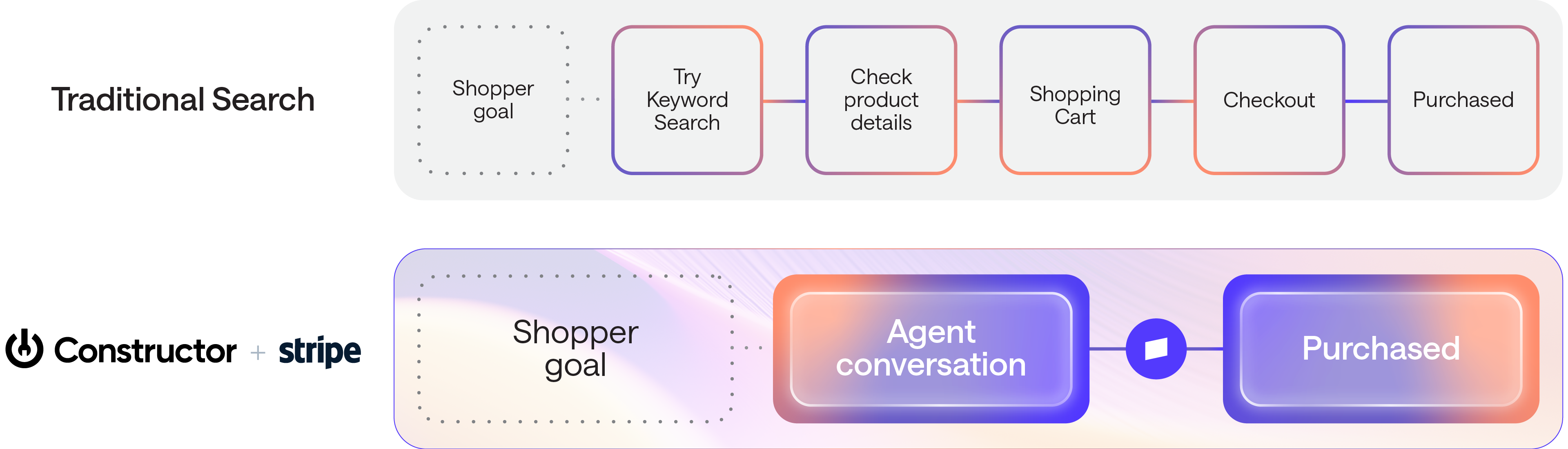
Connecting agentic experiences through shared commerce intelligence
These agentic experiences serve different purposes, but they’re built on a shared foundation.
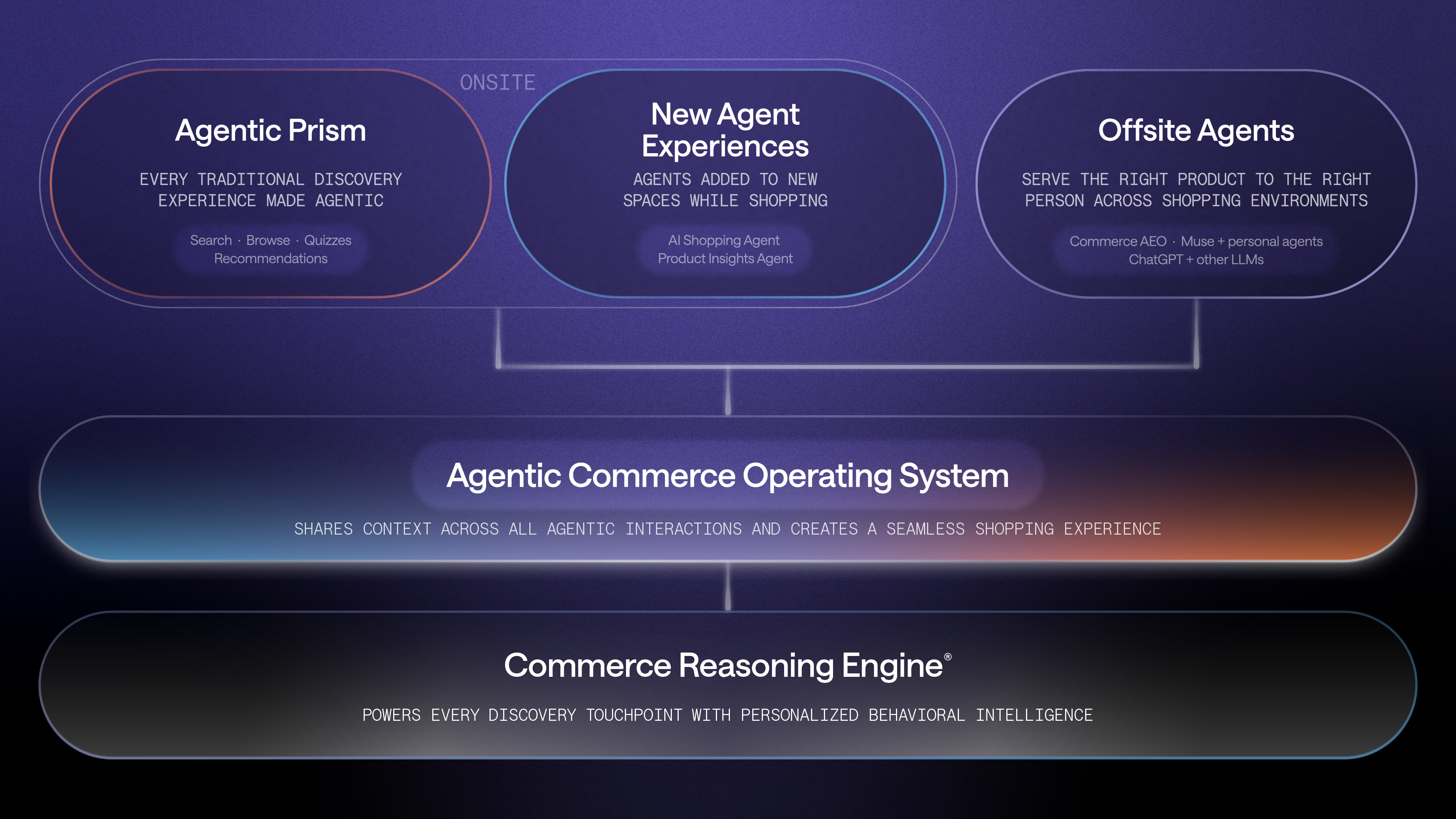
All three draw on the Commerce Reasoning Engine. It’s Constructor’s shared commerce intelligence, purpose-built to connect shoppers with relevant products. It uses shopper behavior and product signals to inform discovery across search, browse, recommendations, and agents, while supporting retailer business goals.
Built on top of the Commerce Reasoning Engine, the Agentic Commerce Operating System is an orchestration layer that connects agentic experiences. It uses shopper intent and context to help route shoppers to the right agent or retrieve information from another connected system. It also shares context across agentic interactions, so shoppers don’t have to start over each time they move between experiences.
For example, a shopper might ask ASA about an existing order. Rather than asking the shopper to find a separate support channel, the experience could connect to the retailer’s support or order management system, bringing the answer into the conversation. The systems available depend on the retailer’s integrations.
The shared intelligence can also inform discovery beyond the conversation. When a retailer uses Constructor for both agents and search and browse, preferences expressed in an agentic conversation can be reflected in what the shopper sees in those discovery experiences — and vice versa.
For more on how these systems work together to help the right shopper find the right product or information at the right time, check out our Q3 Product Roadmap Update webinar.
From shopper intent to personalized shopping assistance
The goal is to provide helpful guidance based on what a shopper is trying to accomplish, not just the words they type into a search bar.
The Agentic Commerce Operating System considers signals such as a shopper’s queries, the pages and products they’ve viewed, and items they’ve added to their cart. Those signals can help determine when an agentic experience might be useful and which assistance to provide.
Here's an illustration of how that plays out. Imagine a shopper browses living room furniture, then types: "My room is tiny. I'm looking for a three-seater sofa" into ASA. Alongside product results, they see a suggestion to refine them to leather or fabric.
Once a product is selected and once on the product detail page (PDP), the shopper asks the product insights agent whether the sofa comes assembled and gets an answer pulled from the product data. An agentic recommendations experience can also help them explore complementary pieces, such as a rug, lamp, or coffee table.
Because a single reasoning engine powers everything, a more connected experience is achieved. Useful guidance emerges as the shopper’s needs change, while shared context helps them continue their journey without having to repeat themselves.
Getting Started with Agentic Commerce
You don't need fully autonomous buying to get value from agentic commerce. Start with agent readiness.
Make commerce data complete, current, structured, and callable
Agents can't recommend what they can't read. Fill in product attributes, keep IDs stable, and expose real-time inventory, price, shipping, and return policies.
The payoff can be real. Shopify reports that AI searches using its structured catalog convert at roughly twice the rate of those relying on scraped or stale data. It's vendor-reported, but the direction is still clear.
The benefits of agentic commerce can extend beyond conversion, helping shoppers make decisions faster while improving operational efficiency in areas such as routine customer support.
Start with bounded use cases
These AI-powered shopping experiences are easier to control than autonomous buying. Plus, they address friction shoppers feel today:
- Guided discovery for broad, goal-based queries
- Product Q&A on the PDP
- Agentic recommendations that adapt within the session
- Cart building for multi-item tasks, such as furnishing a room or planning a trip
- Post-purchase answers, such as order status and delivery timing
One practical detail: keep the conversation context long enough for shoppers to return from a PDP without having to start over. Constructor's agents team suggests about a week, since prices and promotions change after that.
Preserve your controls
Agentic commerce doesn’t mean handing over your storefront to agents. Keep brand, merchandising, consent, payment, risk, fulfillment, and support policies in force for every agent — onsite or off.
Agentic Commerce Examples Using AI-Powered Shopping Assistants
There are many instances of retailers worldwide integrating agentic solutions and AI agents across multiple touchpoints and creating connected experiences that maximize revenue. Below are three short examples:
Retailer-controlled onsite discovery
A shopper types "lawnmower for a large property" into a retailer's search bar.
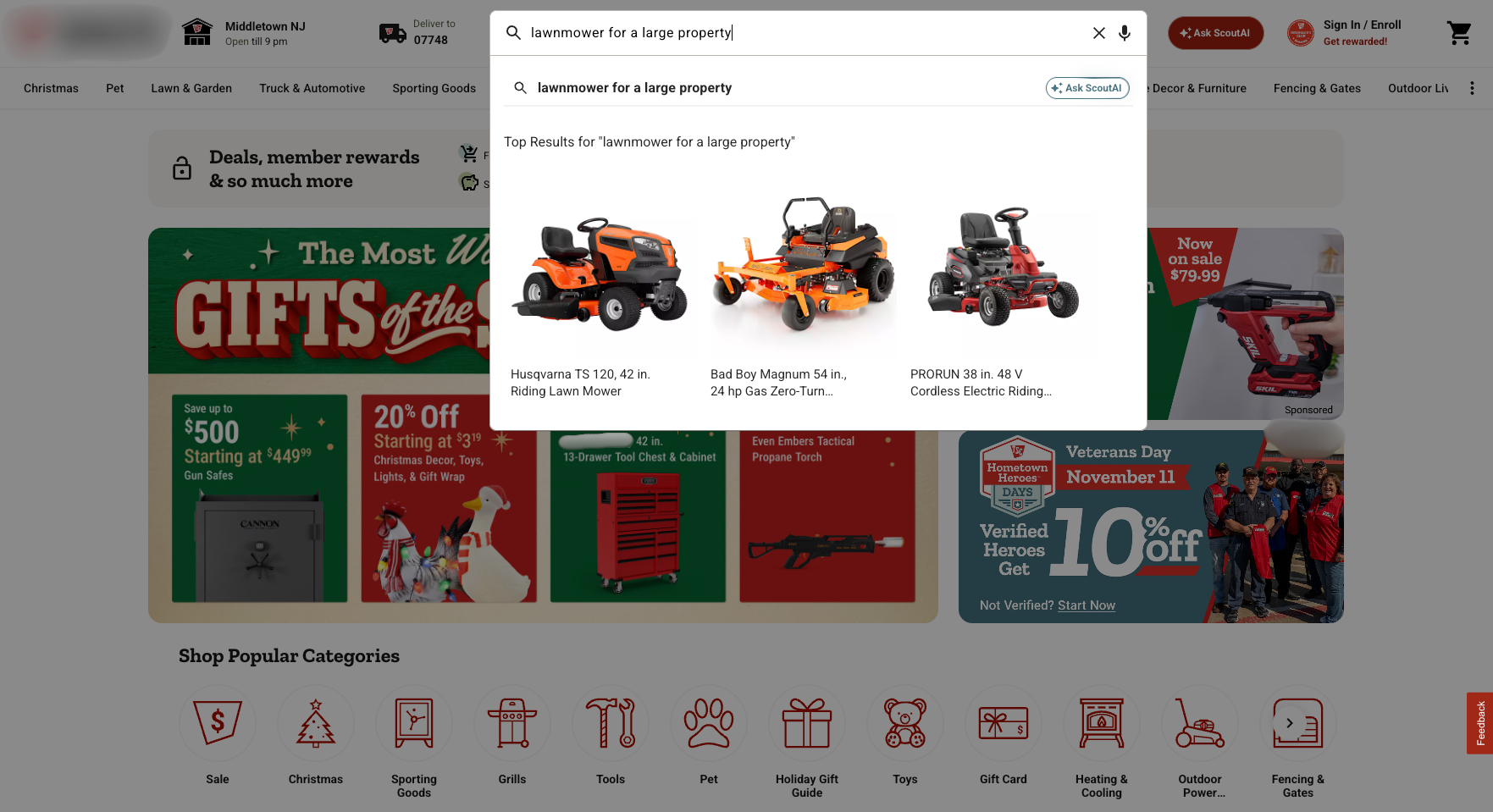
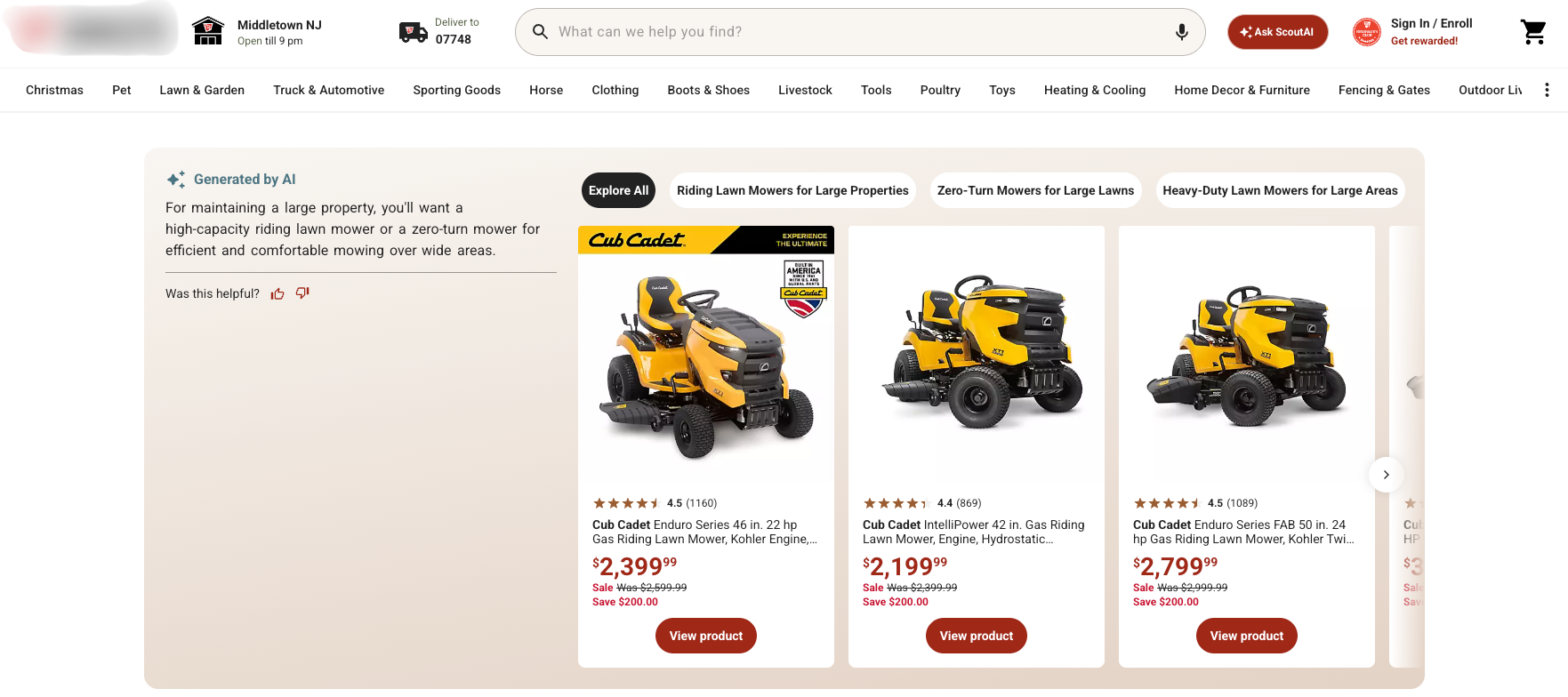
The standard results appear, with a short AI explanation and options across commercial-grade and heavy-duty categories. The shopper can keep refining the conversation, using clickable follow-up prompts instead of guessing what to type.
Delivery questions
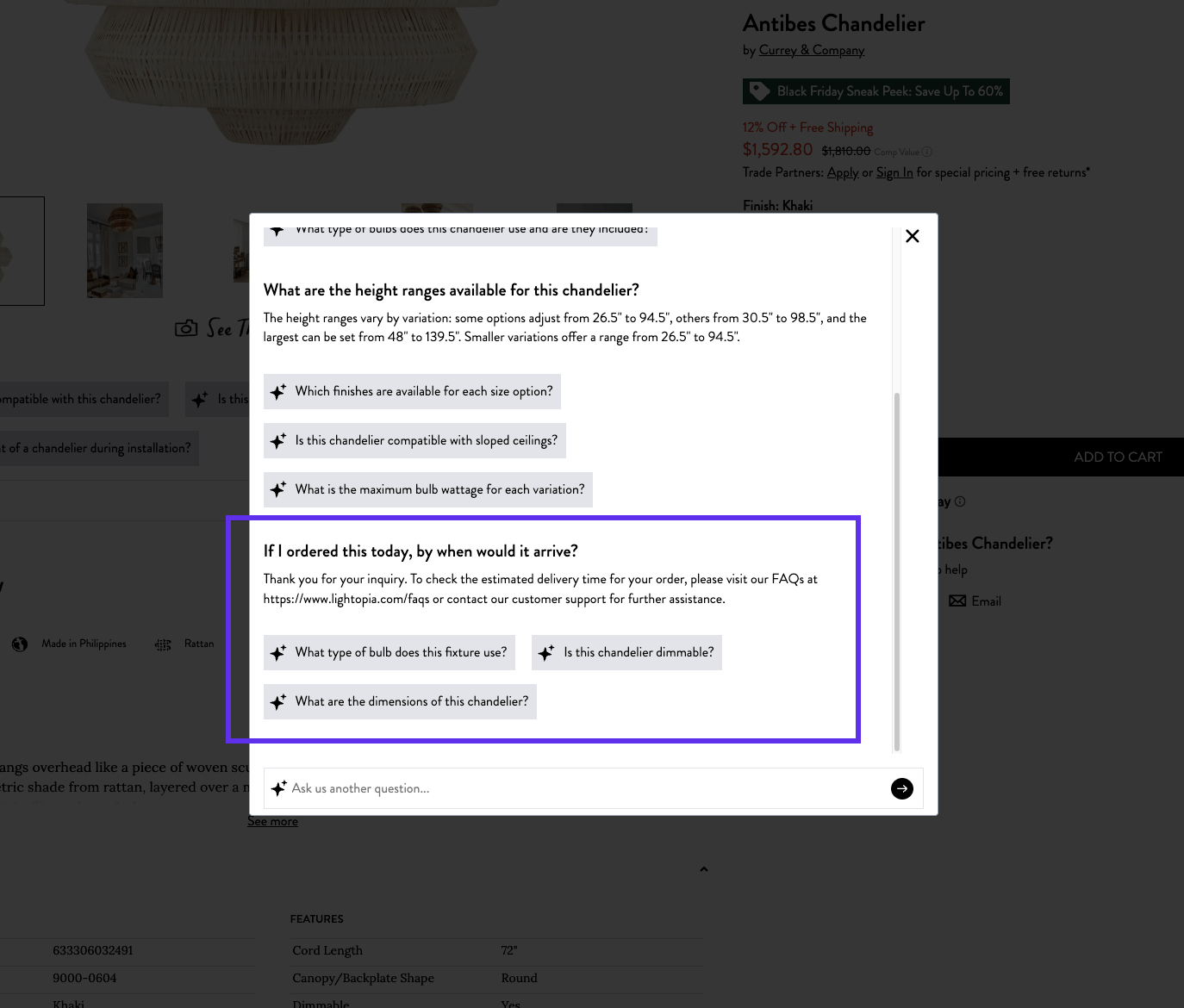
A shopper asks, "If I ordered this by today, by when would it arrive?" in the same assistant they used to shop. The system pulls the answer from order management or a support agent and replies in place.
Dynamic recommendations
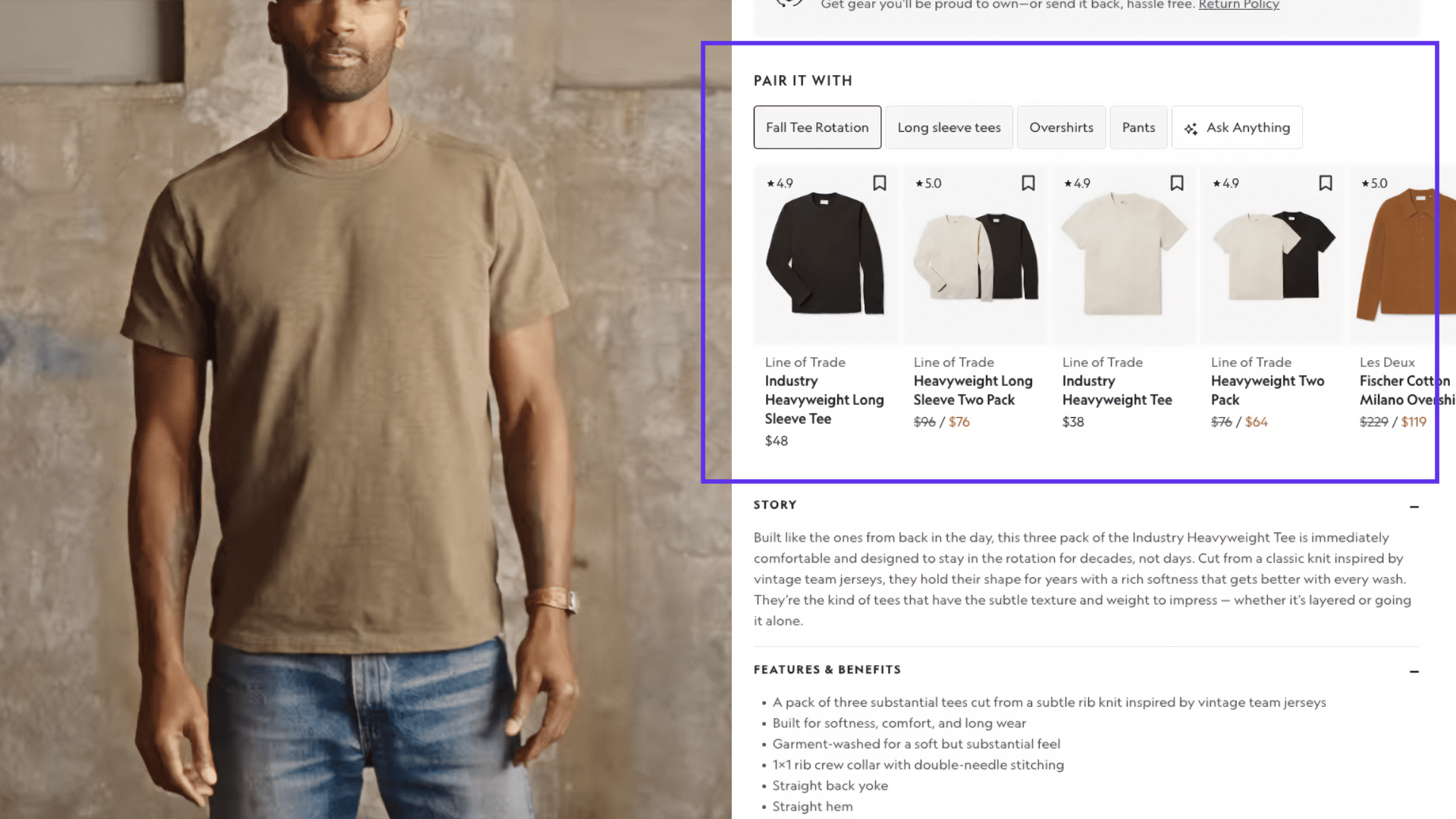
Agentic recommendations use shopper context and shared commerce intelligence to surface relevant products. Shoppers can explore options by selecting a pre-generated label or by asking the agent to refine the recommendations.
Explore more real-world examples from some of our customers in our interactive Agentic Lookbook.
The Bottom Line on AI-Powered Shopping Experiences
Agentic commerce is goal-directed commerce. An AI agent interprets intent, uses your commerce data and tools, refines options, and takes bounded actions with permission.
AI answer engines and personal agents can buy things, but only when merchant integrations, payment methods, identity, user authorization, and risk controls all support the action. Everywhere else, they research, compare, and build carts.
The retailers who benefit most won't have the most agents. They'll have structured, current data, callable capabilities, and a system that routes every shopper's intent to the right experience — from the search bar to checkout and beyond.
Ready to see what an agentic experience could look like on your site? Explore Constructor's approach to agentic commerce.