If you run a grocery ecommerce site, you've probably seen a version of this: a shopper searches for "2% milk." The results page shows oat milk, almond milk, and a branded coffee creamer before any dairy. They try the dairy category instead. The filters are vague. One item they want is listed as available, but never appears in their cart confirmation. They abandon.
Nothing broke. But the basket never got built.
That's what makes grocery ecommerce growth feel uniquely difficult. Grocery ecommerce leaders have a complex set of performance goals to balance: conversion rate, revenue per visitor (RPV), average order value (AOV), and margin. At the same time, shoppers expect speed, accurate availability, relevant results, and substitutions that make sense. Large, frequently changing catalogs add another layer of complexity to search, browse, personalization, and merchandising.
In practice, your team is managing personalized promotions and limited-time offers, wrangling a catalog that changes by the day, and fielding stakeholder requests with limited engineering support.
This playbook is a practical framework for improving online grocery sales via product discovery. That means onsite search, category browsing, recommendations, catalog enrichment, and the personalization that ties it all together.
Why Grocery Ecommerce Growth Is Hard (And Why Product Discovery Compounds Results)
Grocery ecommerce has no single conversion problem to solve. Friction can emerge at every stage of the journey, from finding the right product and building a basket to substitutions and checkout. Rather than tackle every problem at once, the better starting point is identifying where shoppers are dropping out or getting stuck.
The “too many levers” problem
A typical grocery merchandising team is balancing checkout drop-offs, dead-end search queries, margin pressure from promotions, personalization complexity (dietary needs, replenishment cycles, substitution preferences), and an operational workload that never really stops.
It’s not a mistake to care about all of these (as you should!). But it is a mistake to treat them as separate, parallel projects that compete for the same limited bandwidth.
The more productive framing is to treat product discovery as the through-line. When shoppers can find what they're looking for quickly and consistently — and when the experience doesn't collapse the moment an item is out of stock — everything else improves.
Fewer checkout drop-offs. Higher AOV. Lower operational burden on the team.
What product discovery means for grocers
Another hardship is that in most ecommerce verticals, "discovery" is primarily a search-and-browse problem. In grocery, it's the end-to-end experience of building a basket, as in:
- Search results that handle real-world queries (brand variants, misspellings, pack sizes, local vocabulary)
- Category pages that help shoppers filter quickly (dietary needs, organic, price per unit)
- Recommendations that feel like genuine suggestions rather than filler
- Availability signals that guide shoppers toward acceptable substitutes instead of a dead end
- Hyper-local context, where grocers need to rank only what’s in stock, what can ship-to-home, and/or be picked up in-store from a preferred location (since grocery doesn’t ship from a centralized warehouse)
How to improve ecommerce grocery sites via the compounding loop
When discovery works, it creates a flywheel. Findability leads to confidence. Confidence leads to faster basket building. Faster basket building leads to repeat behavior. And each of those repeat sessions gives your system more behavioral data to improve the next one.
That flywheel runs in both directions. When discovery breaks down, even a flawless checkout experience can't recover sessions that never found the right items. Fix discovery first, and the rest of your growth program has a foundation to build on.
Start with the Biggest Conversion Leak: Checkout Friction
Even if your primary goal is to fix product discovery, checkout has a way of quietly capping every other improvement you make. It's worth auditing before anything else.
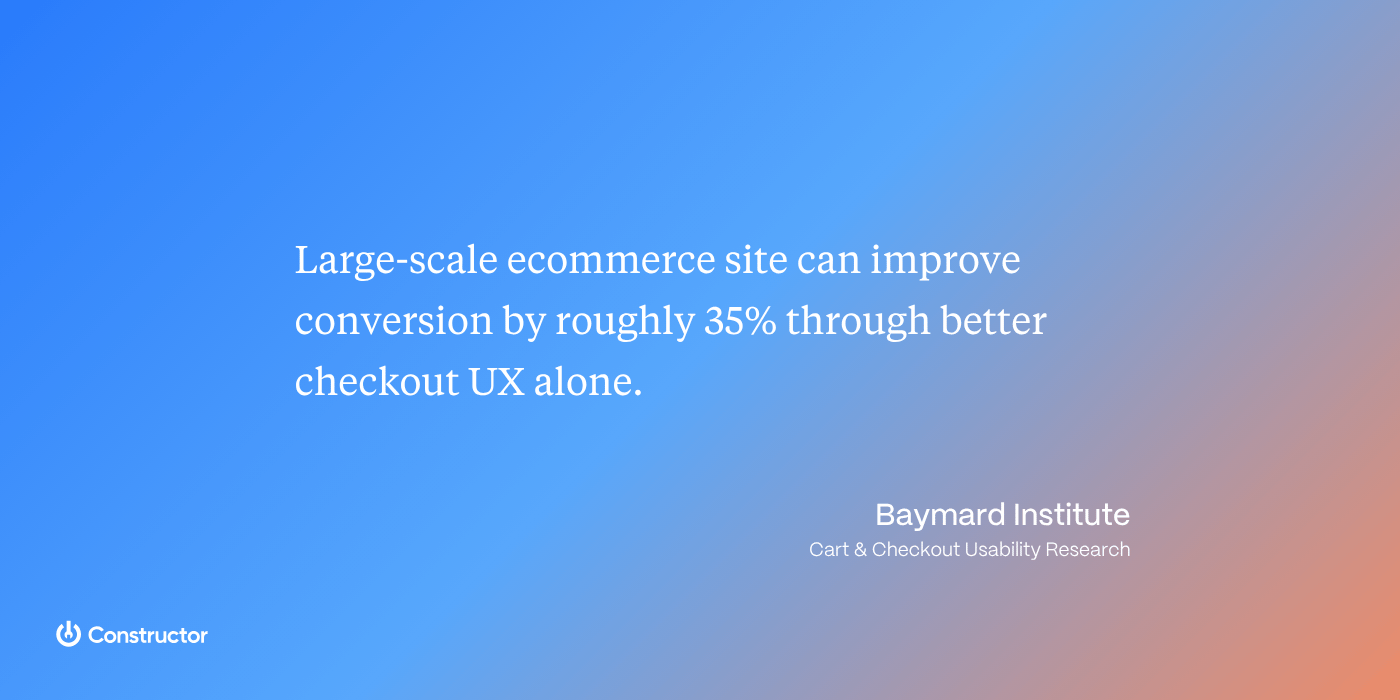
Baymard Institute's meta-analysis of cart abandonment studies puts the average abandonment rate at 70.22%. And Baymard's checkout usability research suggests that a large-scale ecommerce site can improve conversion by roughly 35% through better checkout UX alone.
Those numbers hint that checkout is still one of the most underfixed parts of the shopper journey, particularly in grocery, where complexity around substitutions, fulfillment windows, and fee transparency adds friction that other verticals don't face.
The 2-week checkout checklist
If you only have two weeks, prioritize the fixes that reduce uncertainty and shorten time-to-complete. Here are some areas you can work through:
- Form simplification
- Clearer upfront fee disclosure (delivery, service, and pickup fees are notorious surprises in grocery)
- Substitution preferences that are genuinely easy to set and understand
- Stronger error states for failed payments or unavailable items
Where product discovery supports conversion in the grocery industry
A cleaner checkout experience won't recover sessions that never built a basket in the first place. Shoppers who hit a no-results page, land on a category page with broken filters, or encounter out-of-stock items with no clear path forward abandon long before they reach checkout.
So, after you patch the last-mile leak, move upstream.
Reduce High-Intent Revenue Loss: Fix Ecommerce Site Search Errors and No-Results
Search is where grocery intent gets explicit. Shoppers searching for "organic whole milk half gallon" are on a mission, and every time that mission fails, it's a revenue event.
Google Cloud's grocery-focused research cites that 40%+ of digital grocery visits use search. If search is directionally that important in your business, search failures are both a UX problem and a margin problem.
Search for online grocery shopping fails in predictable ways
Grocery search has specific, consistent failure modes that most teams know well but often lack the tools to fix systematically.
Misspellings ("yoghurt" vs. "yogurt"), brand variants ("Haagen-Dazs" vs. "Häagen-Dazs"), local vocabulary ("pop" vs. "soda"), pack-size queries ("six-pack," "family size," "gallon"), and attribute-heavy searches ("gluten-free pasta with more than 10g of protein") all require layers of understanding that basic keyword matching can't handle.
The search quality checklist that reliably reduces dead ends comes down to five things:
- Autocomplete and autosuggest that guide shoppers toward real inventory rather than catalog entries that don't convert
- Spell correction and typo tolerance
- Synonym and vocabulary mapping across brand names, regional terms, and size descriptors
- Query understanding for grocery-specific patterns
- Query relaxation for zero results (broadening the match to surface close alternatives rather than an empty page)
Industry benchmarks generally treat a no-results rate above 5% as a signal worth acting on. A rate below 2% is a reasonable target to work toward, though your actual threshold will depend on catalog size, freshness, and inventory levels and volatility.
Shorten the search improvement loop
Search improves fastest when teams can run a consistent cycle: find the failing queries (zero-results, low click-through, low add-to-cart), apply targeted fixes (synonyms, rules, ranking adjustments), and measure the impact on search success rate, RPV, and conversion — before starting the cycle again.
The problem most teams face is that this loop gets stuck behind engineering queues. The merchandiser can see what's broken, but they can't fix it without filing a ticket.
Constructor's Search and Autosuggest shortens this cycle. Powered by a central reasoning engine built for commerce use cases, Constructor understands search intent and natural language queries in real time. It dynamically ranks results to match what this shopper means right now, not the most popular item for this keyword.
This means merchandisers can apply synonyms, rules, and ranking adjustments directly in the dashboard without requiring engineering intervention.
|
Customer Story Discover how flaschenpost achieved clear, measurable improvements after adopting Constructor, including a sharp decrease in manual merchandising work such as synonyms, redirects, and boosts. |
Make Browsing Do More Work: Category Pages That Help Shoppers Build a Basket
Search gets the attention, but browse is where baskets get completed. A good grocery category page reduces decision time and makes the “right next item” obvious.
Grocery-specific browse patterns
Category pages built for online grocery shopping need to reflect how people actually plan. Start with patterns that reflect real consumer behavior, such as:
- Meal-based navigation ("Quick Dinners," "Lunchbox Staples," "Breakfast Basics") to help shoppers who know what they need but aren't searching for a specific product
- Dietary facets (gluten-free, keto, vegan, low-sodium), which address a growing segment of shoppers with specific constraints
- Pack size and unit-based filters (snack packs, family size, price per ounce) to answer practical household questions
- Clean brand normalization that prevents facet fragmentation, where "Pepsi," "Pepsi Co.," and "PEPSI" show up as three separate filter options that all mean the same thing.
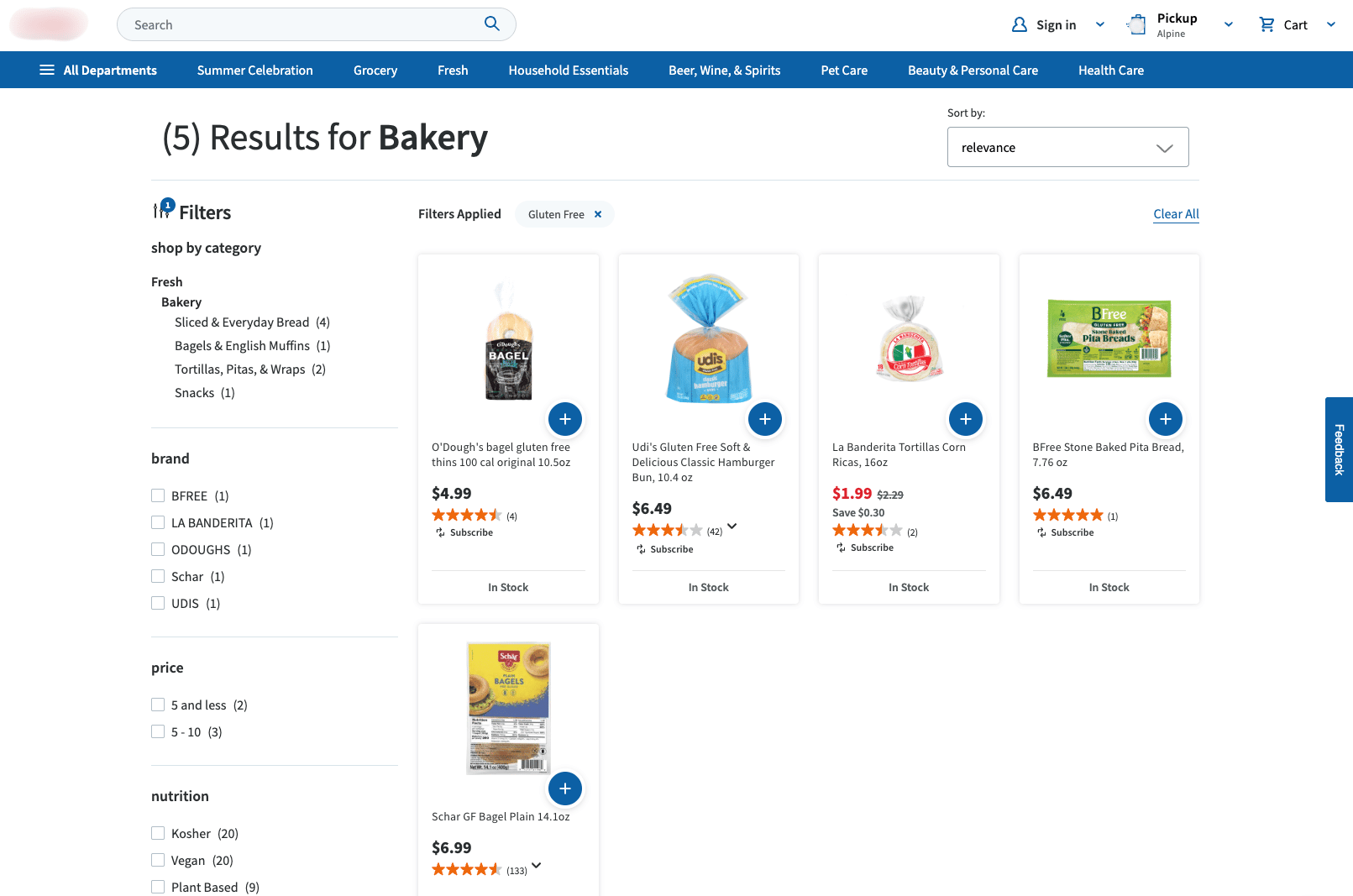
This U.S. grocery retailer lets shoppers filter the Bakery category by the nutrition facets that matter most to them, including kosher, gluten-free, organic, plant-based, and more.
If you're unsure where to start, follow the money and the pain: the top revenue categories, the most-used facets, and the category pages with the highest exit rate.
Designing for out-of-stocks without breaking the journey
Out-of-stocks are inevitable in online grocery stores. A category page or product detail page (PDP) that simply shows "out of stock" with no path forward is a basket-killer. The patterns that work best clearly and early show availability status, offer acceptable substitutes directly in the browse and product page flows, and avoid forcing a full journey restart when one item falls through.
This is also where personalization can do meaningful work at the browse level.
A person who has previously shopped online for a specific grocery brand of oat milk doesn't need to be shown every oat milk SKU in stock. They need to see their preferred brand first, and a reasonable alternative second if it's unavailable.
Constructor's Browse uses AI and real-time behavioral signals to do exactly that, personalizing category page rankings per shopper rather than serving everyone the same sorted grid.
Merchandising governance
Browse improvements tend to lose their effectiveness when they become set-and-forget.
Set guardrails by documenting what rules exist and why, running experiments before hard-coding changes, and building a weekly review of category performance into your team's cadence. (What works for a summer produce category in July may not work in November, and the system should reflect that without requiring an emergency ticket.)
Web performance (site speed)
Web performance matters here, too. Complex category and product pages still need to load quickly and respond smoothly as shoppers search, filter, and build their baskets — especially on mobile devices that may be connected to slow or fast 4G networks. Google's Core Web Vitals measure loading performance (LCP), responsiveness (INP), and visual stability (CLS), providing a useful baseline for identifying experience issues that can get in the way of product discovery.
Grocery browse pages can become heavy quickly, with large product grids, filters and facets, recommendation modules, review stars, and other third-party integrations all competing for resources. Promotional banners and product imagery that haven't been properly compressed add further weight, while dynamically injected content can cause layouts to shift as shoppers browse.
Audit these pages for oversized images, unnecessary or slow third-party scripts, and elements that load or resize after the initial page render; compress and appropriately size imagery, defer non-critical scripts and content, and reserve space for dynamically loaded elements to prevent layout shifts.
Grow AOV (and Protect Margin) with Helpful Shopper Nudges
AOV tactics can backfire when shoppers are buying groceries online if they feel pushy or irrelevant. The goal is basket utility, or helping shoppers complete what they came for.
Bundles and frequently-bought-together
Bundling works best for online grocery retailers when it aligns with routines rather than fabricating reasons to buy. Meal-kit bundles (everything for taco night, pasta night, a weeknight salad), staple replenishment pairings (milk and cereal, coffee and creamer), and seasonal moments (grilling season, back-to-school lunches) all work because they reflect how shoppers actually eat and shop.
But the operative word is “well-designed.” Bundles that feel arbitrary or irrelevant don't move the needle and can actively signal that you don't know your shopper.
Constructor's Recommendations surfaces these connections naturally, using behavioral data and real-time signals to identify which combinations actually lead to add-to-cart events rather than just which products are frequently purchased in the same time period.
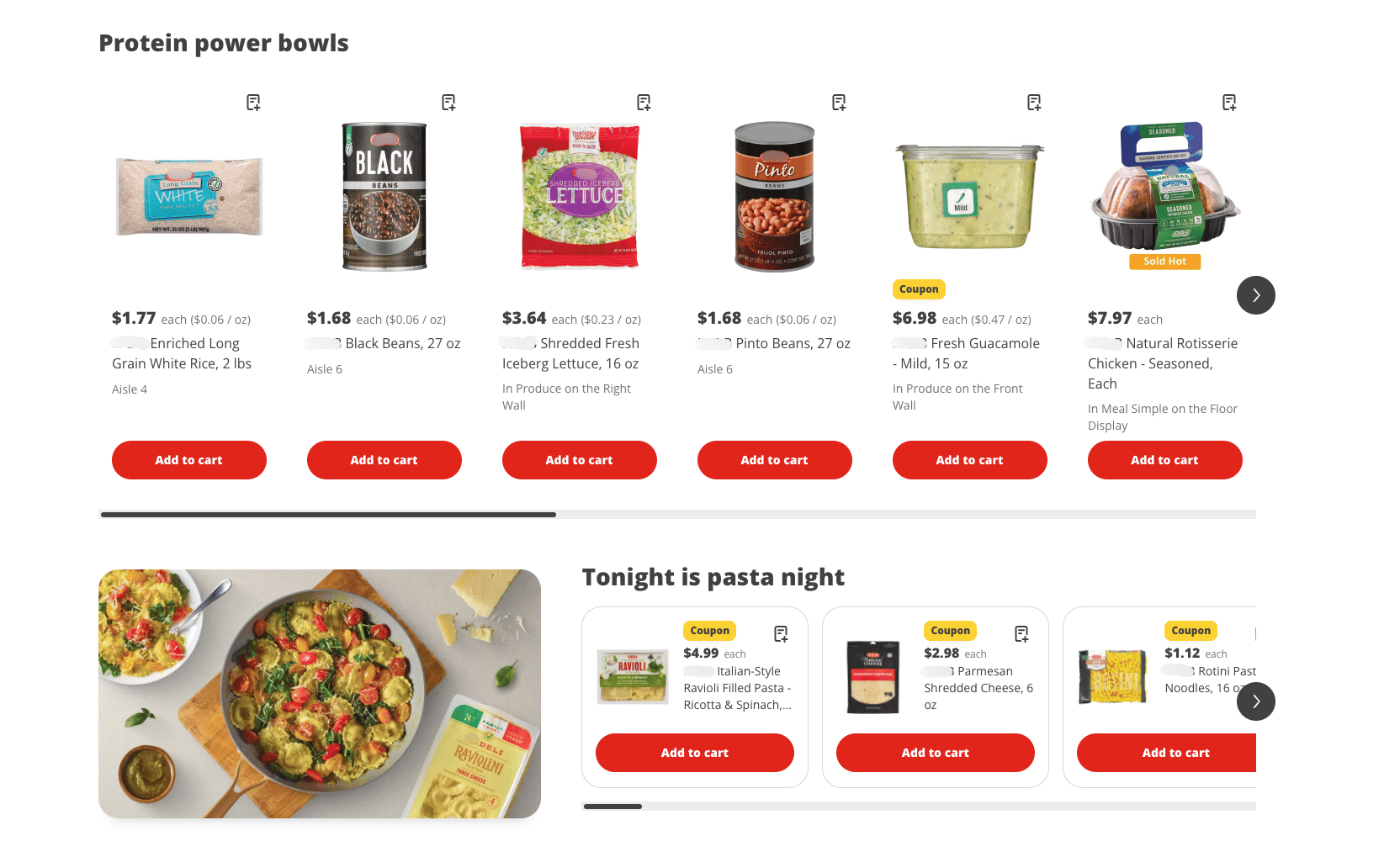
Above is an example of a North American supermarket chain that offers curated recommendations across its site, from PDPs to category pages. Their recommendation pods autopopulate catalog winners based on clickstream data and shopper intent.
Optimize product discovery for margin, not just revenue
The reality of online grocery sales is that tens of thousands of products have varying prices, margins, inventory positions, and literal ‘freshness’ that changes multiple times per week — even per day. And this context can change at the regional and even store levels. It’s impossible to manually merchandise search, browse, and recommendations to optimize for basket building and profit at scale.
Only an AI-powered search and discovery platform that’s inventory- and margin-aware can solve this challenge. Through Merchant Controls and Intelligence, discovery surfaces can self-optimize in real time towards specific business KPIs, such as inventory turnover for deli and fresh produce, margin for household staples, or overall revenue.
Deliver Personalized, Seamless Experiences That Drive Retention
Personalization has been overpromised to online grocery teams for years. Most platforms sell the dream of 1:1 experiences but deliver little more than "shoppers like you also bought" banners on the homepage. The practical path is simpler and more useful.
Don’t simply target shopper segments
Grocery personalization goes much further than customer segments, treating shoppers as “new,” “returning,” “pickup,” or “delivery.” Every shopper has different affinities across brands, products, dietary preferences, price points, and categories — and those preferences can change depending on the shopping mission. They can even shift across physical and online channels, or across your website and grocery app.
It’s important that personalization doesn’t just rely on what shoppers bought last week. It needs to track signals and respond in real-time with relevant and attractive brands, products, and variants that carry the flavors, ingredients, price-points and pack sizes that most likely appeal to an individual shopper in any given moment.
Searches, clicks, category browsing, and products added to the basket provide live signals about what a shopper is trying to accomplish in the current session. A shopper who usually buys the same staples may be planning a dinner party today, shopping for a new dietary need, or simply showing an unexpected preference that their historical profile wouldn't predict.
The strongest personalization combines those signals, continually adjusting the attractiveness of products for the individual shopper as they move through the experience. Search results, category rankings, and recommendations can then respond to both established preferences and what the shopper is signaling right now.
Provide contextual patterns that feel helpful, not intrusive
McKinsey's research on personalization ROI finds that personalization most often drives 10–15% revenue lift, with company-specific outcomes ranging from 5–25%. That spread reflects something real: personalization compounds when it's grounded in accurate behavioral signals, and it underwhelms when it's built on segmentation that's too coarse or data that's too stale to be useful.
The personalization that online grocery shoppers actually notice — and appreciate — tends to be functional rather than flashy. Replenishment prompts for staples based on purchase history ("You usually order coffee around this time — still interested?") are genuinely useful. Substitution preferences that carry across orders ("always allow store brand" or "no substitutions on fresh produce") reduce post-delivery friction. Delivery-slot-aware ranking — surfacing items most likely to be fulfillable in the shopper's chosen window — builds confidence at the moment it's most needed.
This is where search engines like Constructor’s shine.
Constructor personalizes the end-to-end discovery experience — across Search, Browse, Recommendations, Collections, AI Shopping Agent, Retail Media, offsite channels, and more touchpoints — thanks to full verified clickstream data, petabytes of commerce data, and other commerce-specific signals. That means customer behavior in Search informs what they see in Browse, and their browse history informs what recommendations they're shown on PDPs.
It's one interconnected personalization system powered by a single reasoning engine.
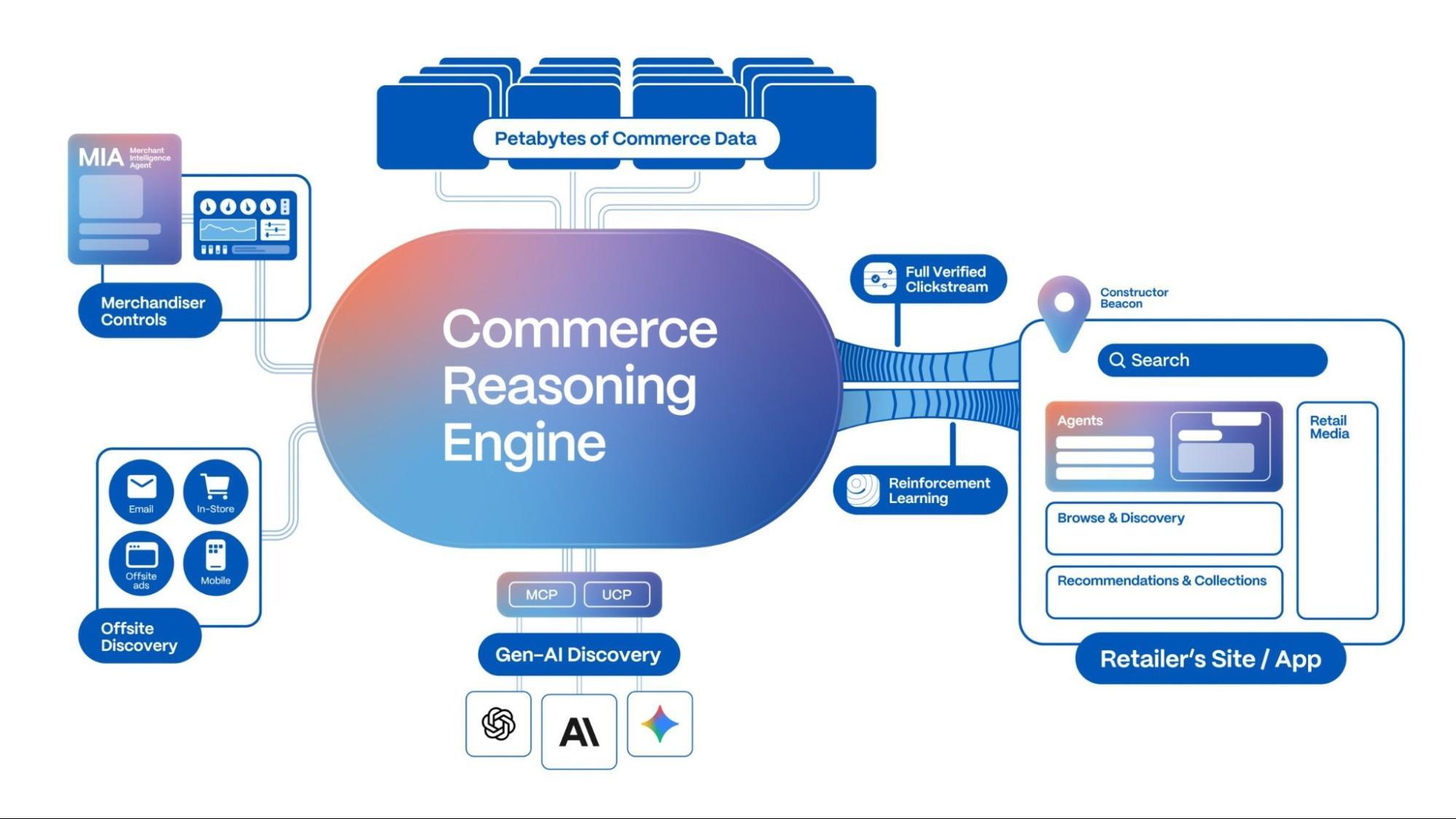
That intelligence can also extend beyond the site, using onsite behavior to shape personalized offers and promotions across channels such as email marketing and push notifications within your grocery app — and bringing those interactions back into the shopper's evolving profile.
Measure personalization on the right metrics
As you mature your personalization program, evaluate it on incrementality: incremental RPV per visitor, repeat purchase rate, and search success rate.
If you're only measuring personalization against last-click conversion, you're likely understating its impact on loyalty and overstating its short-term revenue contribution.
Save Merchandising Team Time and Optimize Operations: Automate Catalog Enrichment
Here's a pattern that's predictable across enterprise grocery teams: the catalog is growing faster than the team can keep up with.
New SKUs get added with minimal metadata. Brand names are inconsistent. Dietary tags are incomplete. And because the attributes that power search recall and faceted browsing are missing or wrong, the merchandising team spends hours each week creating workarounds (e.g., synonyms for things that should be tagged, manual rules for queries that should be handled automatically, etc.).
Catalog enrichment is a product discovery multiplier because it fixes the problem at the source.
Enrichment as the prerequisite for everything else
The attributes that matter most in grocery are those that appear in high-intent queries and high-usage facets: dietary preference tags (gluten-free, organic, vegan, kosher), brand normalization, pack size and unit count, flavor and variety, and freshness or local indicators, where relevant. When these are missing or inconsistent, you get lower search recall, broken facets, more zero-results queries, and more manual work from a team that's already stretched.
Those attributes increasingly matter to how shoppers discover products online. NielsenIQ points to growing demand for grocery products aligned with specific dietary needs and preferences, with online grocery experiences responding through dietary filters, richer nutritional information, and personalized recommendations.
Constructor's Attribute Enrichment fuses generative AI and machine learning to extract, clean, and enrich product data — automatically creating the categories, attributes, and metadata that power accurate search and browse results, and populate filters and facets.
One major U.S. fashion and apparel brand used it to build a synonym map for the attribute "fabric" that automatically generated values like "fleece," "fleece-lined," "cloud fleece," and a dozen other variants from actual shopper queries — so shoppers who searched using their own language found results, rather than dead ends.
.png?width=1300&height=744&name=attribute-enrichment-catalog@2x%20(2).png)
The grocery industry equivalent is a systematic enrichment pass on dietary tags, brand normalization, and pack sizes: the three attribute sets that frequently appear in queries that currently return zero results.
The enrichment pilot
Rather than attempting catalog-wide enrichment in one pass, run a structured pilot. Choose the categories that drive the highest search volume. Define attribute standards. QA for accuracy using a sample set before applying at scale. Then measure the impact on zero-results rate, search success rate, and — critically — how many hours per week your merchandising team reclaims from manual tagging work.
That last metric tends to get less attention than conversion lift, but for a team of two or three merchandisers managing a catalog of tens of thousands of SKUs, even five hours per person per week is a meaningful operational win.
Measuring Success: The Minimum Viable Online Grocery Store KPI Dashboard
If you don't measure discovery, you can't manage it. The following key performance indicators (KPIs) set gives you visibility across the shopper journey — from search intent to basket value to checkout completion — without requiring a business intelligence buildout before you can start.
Conversion metrics track whether shoppers are completing their intent: conversion rate (CVR), add-to-cart rate, and checkout completion rate. These are the indicators that discovery is working end-to-end.
Basket and value metrics measure the quality of the sessions that do convert: AOV, RPV, and margin per order. In grocery, RPV is usually more useful than conversion rate alone because it accounts for order size, not just frequency. Margin per order is the metric that prevents promotions and threshold strategies from creating the illusion of growth while eroding profitability.
Discovery metrics give you direct visibility into product discovery performance: search success rate (the share of search sessions that result in at least one click), zero-results rate, search results click-through rate, and engagement with recommendation modules (CTR and add-to-cart rate). These are the leading indicators. When they move, conversion and revenue metrics follow — with a short lag.
Experimentation cadence is what ties the dashboard to action. Aim for two to three controlled tests per month. Pre-register your success metrics before each test starts — RPV and margin per order, not just conversion rate — and run tests long enough to account for differences in weekday/weekend online shopping behavior. The teams that improve fastest aren't necessarily the ones with the most sophisticated analytics stack. They're the ones running experiments consistently and building institutional knowledge about what actually moves the needle for their many shoppers.
Your 90-Day Growth Roadmap for Your Grocery Ecommerce Platform
The compounding logic of this playbook points to a natural sequencing: start with the biggest leaks (checkout friction and search dead ends), then strengthen browse and basket-building experiences, and finally scale personalization and enrichment.
The roadmap below translates that into a working timeline.
Weeks 0–2: baseline, checkout, and quick wins
This phase is fast by design. The goal is to stop the bleeding and establish the measurement foundation before you start building. That could mean:
- Baseline the full KPI dashboard: RPV, search success rate, zero-results rate, checkout completion rate, etc.
- Run a checkout audit and fix the top friction points: guest checkout, error states, fee transparency, substitution preference clarity, etc.
- Identify the top 200 failing search queries and implement synonyms, typo tolerance, and no-results mitigation for the highest-volume ones
Weeks 3–8: browse, recommendations, and enrichment pilot
This is the phase where the flywheel starts turning. Discovery quality improves, boosting basket-building rates, which feed more behavioral data back into the system:
- Improve category page UX for the top revenue categories. This could mean you add the facets that reflect actual shopper filtering behavior (dietary, pack size, brand), and clean up brand normalization when fragmentation creates filter confusion
- Deploy "complete the basket" and "frequently bought together" recommendations in the highest-traffic browse and product page flows
- Start a catalog enrichment pilot on the SKU set with the highest search volume and the most incomplete attribute coverage
Weeks 9–16: scale the discovery program, expand personalization, formalize governance and reporting
In this final stretch, you can focus on finessing the final details:
- Formalize the governance cadence: weekly review of query performance, experimentation results, and category-level KPIs
- Expand personalization from basic segmentation (new customer base vs. returning customers, pickup vs. delivery) into contextual patterns: replenishment prompts, substitution preferences, delivery-slot-aware ranking
- Build reporting that ties discovery KPIs directly to business outcomes so next quarter's conversation with leadership is grounded in data, not anecdotes
Final Words: The Goal Isn’t ‘Better Search.’ It’s a Discovery Flywheel That Improves the Customer Experience
The shopper who builds their basket in under five minutes, checks out without surprises, gets reasonable substitutions on the two things that were out of stock, and finds the experience repeatable enough to make you their default grocery destination? That's the outcome this entire playbook is working toward.
None of the individual improvements in this guide is magic. But they compound. Fix checkout friction, and you stop losing sessions at the last step. Fix search dead ends, and you stop losing high-intent shoppers at the first step. Improve browse and recommendations, and the average basket gets bigger. Enrich the catalog, and every layer of discovery gets more accurate. Personalize the experience, and shoppers feel known rather than generic, improving customer satisfaction and overall customer retention.
Each improvement creates the conditions for the next one. That's the discovery flywheel. Once it's running, it's genuinely hard to stop.
Constructor is built to power this flywheel as a unified platform rather than a set of disconnected point solutions. If you want to see how it applies specifically to your grocery ecommerce, a Search Experience Audit is a good place to start. No strings attached.