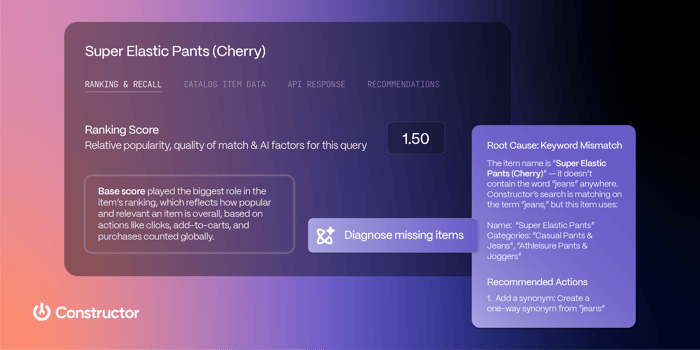
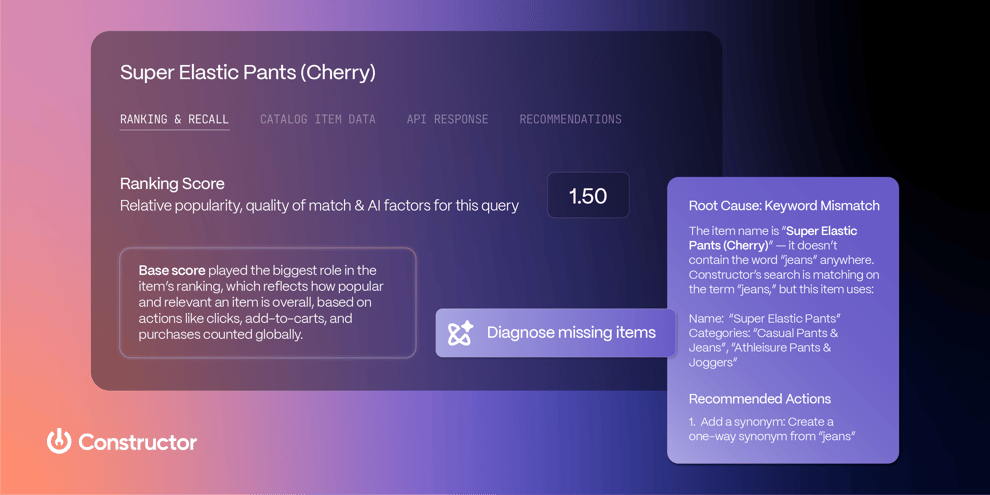
The increasing complexity of search and merchandising decisions facilitated by AI has led to an explainability problem for merchandisers. They’re expected to explain outcomes shaped by dozens of moving parts: ranking models, behavioral signals, campaign settings, and searchandizing rules.
On any given day, someone on their team needs to answer:
- Why is this item not showing up?
- Why does the promo rank so low?
- What changes should I make to boost performance?
The challenge with AI-powered tools is that they often provide facts and decisions but can’t explain their reasoning.
So merchandisers are left doing what they do best: They click through dashboards. They cross-check settings. They compare date ranges. They piece together clues and try to reconstruct cause and effect from scattered views.
And systems continue operating at machine speed while the burden of reasoning remains with the human, resulting in decisions that take longer and “safe” changes winning over better changes.
So we came up with a solution that lets the AI respond and explain its reasoning, called the Merchant Intelligence Agent (MIA).
Merchant Intelligence Agent (MIA) is an intelligence layer inside the Constructor merchandiser dashboard that turns ‘why did this happen?' from rhetorical self-talk into a question a merchandiser can just ask the system directly — and get an answer in plain language.
MIA is designed for the people closest to the work: merchandisers, analysts, and product managers who spend their days trying to make sense of performance and turn insights into action. It makes the day-to-day easier and is a new way to show what “AI-first” looks like when it’s built for real operations.
|
Why explainability matters now Merchandising used to be mostly configuration. Now it’s configuration plus algorithmic decision-making. Ranking shifts because behavior changes. Campaign outcomes depend on interactions across the site. A single tweak can have side effects you won’t see until it’s already impacted revenue. On top of that, AI creates further complexity. While AI helps optimize rules and processes, it adds an extra layer of ambiguity, making it hard for humans to fully understand what’s happening and make the most informed decisions in a timely manner. In this environment, dashboards that only present information aren’t enough. Teams need tools that can:
That’s the job MIA was built to do. |
What MIA Does
MIA not only helps merchandisers instantly understand the full context of performance, search, and conversion results in natural language, but it also enables them to make more informed decisions faster, thereby improving results more quickly. The agent will also proactively recommend actionable next steps to improve performance further and assist in implementing them automatically through scalable agentic workflows.
Below, we break down that entire process and how it helps ecommerce teams:
1) Provides clear, contextual explanations right where you work
MIA generates in-dashboard explanations (think of them like GenAI blurbs) for questions like:
- Why is this item not showing up?
- Why does the promo rank so low?
- What changes should I make to boost performance?
- Any other question a merchandiser might need to answer
Merchandisers can also ask MIA directly via chat for further explanation. For example, MIA could respond: “It is because you set a rule that prohibits summer clothes from showing up in the winter. Do you want me to brainstorm ideas on how you can change this rule to improve business outcomes?”
What makes MIA different from generic AI answers is the grounding. Each explanation and suggestion checks your environment — your merchandising rules, ranking factors, and performance data — then connects cause and effect in one place. So, you get an answer that’s tied to real inputs: configuration + shopper outcomes + what changed.
.webp?width=1136&height=711&name=General%20Explainability@2x%20(1).webp)
2) Helps teams make decisions with more confidence
When ranking feels like a black box, the safest move is often “do nothing.” But doing nothing has a cost, especially when you’re trying to react to performance shifts quickly.
MIA shortens the time between question → understanding → change. The AI spots root causes more quickly and then provides explanations and suggestions for next steps. Once a human approves, MIA can then automate the next steps.
That matters for:
- Merchandisers, who need to move fast without breaking what already works
- Analysts, who get pulled into explainers and ad-hoc questions
- Product managers, who need clear signals to prioritize the right experience improvements and align stakeholders
- Executives, who get instant answers to ensure decisions are informed by the reality of merchandising performance
Explanations are step one. Step two is: “Okay, what should we change?”
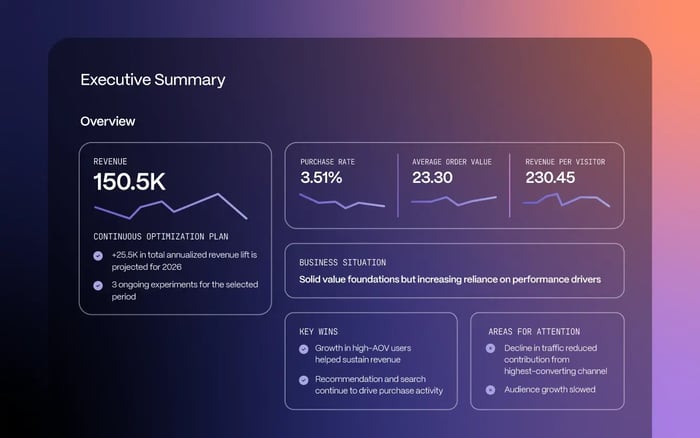
3) Turns insight into next steps (and soon, implementation)
MIA also suggests actionable next steps based on real-time results and your environment's constraints. This allows teams to move from observation to action without guesswork — or extensive research.
Where we’re heading next with MIA is automated campaign creation. When MIA’s next steps are approved by the human merchandiser, the agent can proceed to automatically create campaigns, rules and settings, with the human user only needing to review and approve - transforming campaign building into a matter of prompting and clicking, not a ticket and a waiting period.
.webp?width=900&height=563&name=Generating%20Suggested%20Next-Actionable%20Steps@2x%20(2).webp)
What You Can Ask MIA
Here are a few common “in-the-weeds” questions MIA is designed to handle:
- “Could you summarize what changed since last week?”
Quickly understand what shifted without manually comparing dashboards and settings. - “What should I do to improve this campaign?”
Get concrete recommendations that reflect what’s happening now, not generic best practices. - “Why is this item not showing up?”
Find out whether inventory, filtering, eligibility rules, campaign settings, or recent behavior changes are preventing the item from appearing in results. - “Why does the promo rank so low?”
See what signals, rules, and performance patterns are holding the promo back and understand what’s influencing its position. - “What changes should I make to boost performance?”
Get specific recommendations based on current results so you can make informed adjustments rather than rely on guesswork.
Why This Matters, Even If It’s Not a Buying Trigger
MIA isn’t meant to be the headline in an enterprise business case. It’s meant to be the thing your team uses on a Tuesday afternoon when you get a Slack message from senior leadership asking why they don’t see the new promotion ranking first, and you need an answer quickly to take action.
By reducing operational friction, lowering dependence on tribal knowledge, and helping more people feel confident in taking action faster, you don’t just depend on the one person who “knows how it works.” You empower your entire team to find the answers and explanations they need to pick a solution and move the business forward.
And even despite all the AI-driven advancements, humans will still need to remain in the loop, bringing their deep domain knowledge and business foresight to the table to sustain a differentiated brand.
If you want a deeper look at MIA’s capabilities — AI understandability, recommendations, and what’s coming next — visit the Merchant Intelligence Agent page.